
Introduction
Choosing the right insulation material is an important decision for industrial buildings, commercial spaces, warehouses, cold storage facilities, HVAC systems, factories, and infrastructure projects.
The right insulation can help reduce unwanted heat transfer, improve energy efficiency, maintain controlled temperatures, support equipment performance, and enhance indoor comfort. However, there is no single insulation material that is best for every application.
In India, different insulation materials are selected based on factors such as temperature, application, moisture exposure, fire performance, thermal conductivity, installation requirements, durability, and project budget.
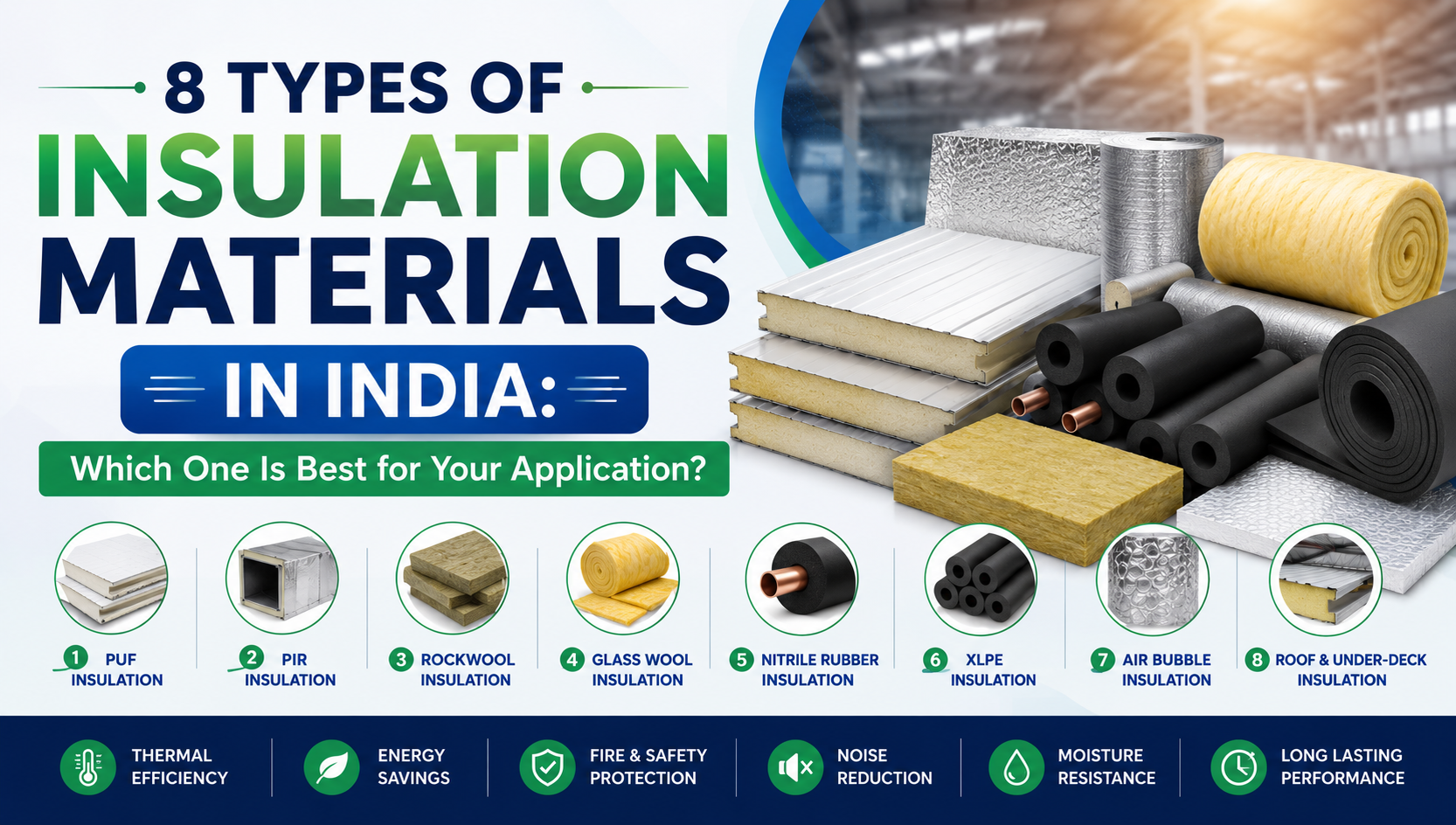
The most commonly used insulation materials include PUF, PIR, Rockwool, Glass Wool, Nitrile Rubber, XLPE, Air Bubble Insulation, and roof or under-deck insulation systems.
In this guide, we explain the 8 major types of insulation materials used in India, their benefits, applications, and how to choose the right solution for your project.
What Are the Main Types of Insulation Materials in India?
The main types of insulation materials used in India include PUF (Polyurethane Foam), PIR (Polyisocyanurate), Rockwool, Glass Wool, Nitrile Rubber, XLPE, Air Bubble Insulation, and specialized roof or under-deck insulation systems.
The best insulation material depends on the specific application. For example, PUF is widely used for cold storage and insulated panels, PIR is commonly used for pre-insulated HVAC ducts, Rockwool is suitable for applications requiring fire and acoustic performance, and Nitrile Rubber is often used for HVAC and refrigeration pipe insulation.
What Is Insulation Material?
Insulation material is a material designed to reduce or control the transfer of heat, sound, or, in some applications, fire between different spaces or surfaces.
In thermal insulation, the primary purpose is to slow down heat transfer. This can help keep a cold space cold, a heated space warm, or reduce the amount of external heat entering a building.
Insulation materials are used in:
- Industrial buildings
- Factories
- Warehouses
- Cold storage facilities
- HVAC systems
- Commercial buildings
- Pharmaceutical facilities
- Food processing plants
- Roofs and industrial sheds
- Pipes and ductwork
The correct insulation system can contribute to better energy efficiency, temperature control, equipment performance, and long-term operational savings.
Why Is Insulation Important in India?
India has a wide range of climatic conditions, from extremely hot regions to cold and humid environments. Industrial and commercial buildings can also experience significant heat gain through roofs, walls, ducts, pipes, and other building components.
Effective insulation can help address several challenges.
1. Reducing Heat Transfer
Insulation helps reduce unwanted heat movement between the inside and outside of a building or system.
This is particularly important for:
- Factories
- Warehouses
- Industrial sheds
- Cold rooms
- Refrigeration systems
- HVAC installations
2. Improving Energy Efficiency
When heat transfer is controlled, heating and cooling systems may not need to work as hard to maintain the desired temperature.
This can help improve HVAC efficiency and potentially reduce energy consumption.
3. Maintaining Temperature
Cold storage, pharmaceutical facilities, food processing units, and other temperature-controlled environments require stable conditions.
Proper insulation helps reduce temperature fluctuations and supports the performance of refrigeration and cooling systems.
4. Improving Indoor Comfort
In commercial and residential buildings, insulation can help reduce heat entering through roofs and walls, contributing to a more comfortable indoor environment.
5. Supporting Fire Safety
Certain insulation materials, such as Rockwool, are selected for applications where fire resistance and high-temperature performance are important.
The correct material should always be selected according to the project’s specific fire safety requirements and applicable standards.
6. Reducing Condensation
Insulation can help control surface temperatures and reduce the risk of condensation on chilled pipes, ducts, and HVAC systems when properly designed and installed.
8 Types of Insulation Materials Used in India
Let’s explore the most common insulation solutions and their applications.
1. PUF Insulation
PUF stands for Polyurethane Foam.
PUF is a widely used insulation material known for its excellent thermal insulation performance and low thermal conductivity.
It is commonly used in the form of insulated panels and sandwich panels for temperature-controlled environments.
Common Applications of PUF
- Cold storage
- Cold rooms
- Freezer rooms
- Food processing facilities
- Pharmaceutical storage
- Industrial buildings
- Warehouses
- PUF insulated panels
- Insulated roofing and wall systems
Benefits of PUF Insulation
- Excellent thermal insulation
- Helps reduce heat transfer
- Lightweight construction
- Suitable for temperature-controlled environments
- Available in different panel thicknesses
- Fast installation when used in pre-engineered panel systems
Best For
PUF is particularly suitable for cold storage, cold rooms, insulated panels, and applications where effective thermal insulation is required.
2. PIR Insulation
PIR stands for Polyisocyanurate.
PIR is a rigid insulation material commonly used in high-performance thermal insulation applications. It is widely associated with pre-insulated duct systems and other applications where thermal performance and fire characteristics are important considerations.
PIR ducts combine the duct structure and insulation into a single pre-insulated system.
Common Applications
- PIR ducts
- Pre-insulated HVAC ducts
- Commercial buildings
- Hospitals
- Pharmaceutical facilities
- Clean rooms
- Industrial facilities
- Office buildings
- Shopping malls
Benefits of PIR Insulation
- High thermal insulation performance
- Lightweight
- Easy to handle
- Faster installation compared with separately insulated duct systems
- Helps reduce thermal losses
- Suitable for modern HVAC applications
Best For
PIR is an excellent option for pre-insulated HVAC duct systems and applications requiring efficient thermal insulation.
3. Rockwool Insulation
Rockwool, also known as mineral wool, is manufactured from mineral or rock-based materials and is widely used in industrial and commercial insulation applications.
One of its major advantages is its ability to provide thermal insulation along with fire and acoustic performance.
Common Applications
- Industrial buildings
- HVAC systems
- Industrial equipment
- Fire-resistant applications
- Acoustic insulation
- Factories
- Commercial buildings
- Manufacturing facilities
Benefits of Rockwool
- Good thermal insulation
- Excellent fire performance in suitable products and systems
- Acoustic insulation properties
- Suitable for high-temperature applications
- Available in boards, blankets, and other forms
Best For
Rockwool is a strong choice for applications where thermal insulation, fire performance, and acoustic control are important considerations.
4. Glass Wool Insulation
Glass Wool is a fibrous insulation material made primarily from glass fibers. It is widely used in buildings and HVAC systems.
It is lightweight and commonly available in rolls, blankets, and other forms.
Common Applications
- HVAC ducts
- False ceilings
- Walls
- Commercial buildings
- Industrial buildings
- Acoustic applications
- Air-conditioning systems
Benefits of Glass Wool
- Lightweight
- Good thermal insulation
- Acoustic properties
- Easy to handle in suitable forms
- Widely used in HVAC applications
Best For
Glass Wool is commonly used for HVAC systems, building insulation, false ceilings, and applications where thermal and acoustic performance are required.
5. Nitrile Rubber Insulation
Nitrile Rubber insulation is a flexible, closed-cell insulation material widely used for HVAC, air-conditioning, refrigeration, and chilled-water pipe applications.
Its flexibility makes it suitable for insulating pipes and components with bends and complex shapes.
Common Applications
- AC copper pipes
- HVAC piping
- Chilled water pipes
- Refrigeration systems
- Cooling systems
- Industrial piping
Benefits of Nitrile Rubber
- Flexible
- Closed-cell structure
- Helps reduce condensation when properly installed
- Good moisture resistance
- Suitable for HVAC and refrigeration applications
- Easy to install around pipes and fittings
Best For
Nitrile Rubber is particularly suitable for HVAC, air-conditioning, refrigeration, and chilled-water pipe insulation.
6. XLPE Insulation
XLPE stands for Cross-Linked Polyethylene.
XLPE insulation is a closed-cell insulation material used in various thermal insulation applications, including piping and HVAC-related systems.
Common Applications
- HVAC pipes
- Chilled water systems
- Refrigeration applications
- Industrial piping
- Thermal insulation systems
Benefits of XLPE
- Closed-cell structure
- Low moisture absorption
- Good thermal insulation
- Lightweight
- Easy handling
- Suitable for various piping applications
Best For
XLPE can be considered for HVAC and pipe insulation applications where a lightweight, closed-cell insulation material is required.
7. Air Bubble Insulation
Air Bubble Insulation is a reflective insulation solution that typically consists of air-filled bubbles enclosed between reflective layers.
It is commonly used for roof and building applications, especially where reducing radiant heat gain is a priority.
Common Applications
- Industrial roofs
- Factory sheds
- Warehouses
- Commercial buildings
- Roof heat reduction
- Under-roof applications
Benefits of Air Bubble Insulation
- Lightweight
- Easy to handle
- Quick installation
- Helps reduce radiant heat gain
- Suitable for roof applications
- Can be useful in hot climates when properly designed and installed
Best For
Air Bubble Insulation is commonly considered for industrial roofs, warehouses, factory sheds, and applications focused on reducing heat gain.
8. Roof and Under-Deck Insulation
Roof and under-deck insulation systems are designed to reduce heat entering a building through the roof.
This type of insulation is especially relevant for industrial buildings, warehouses, factories, and large commercial structures where roof heat gain can significantly affect indoor temperatures.
Depending on the project, different insulation materials may be used.
These can include:
- Air Bubble Insulation
- Glass Wool
- Rockwool
- Other reflective insulation systems
- Specialized roof insulation products
Common Applications
- Factory sheds
- Industrial warehouses
- Manufacturing plants
- Commercial buildings
- Large storage facilities
- Industrial roofing systems
Benefits
- Helps reduce heat gain through roofs
- Can improve indoor thermal comfort
- May reduce cooling requirements
- Suitable for large industrial spaces
- Can be installed as part of roof or under-deck systems
Best For
Roof and under-deck insulation is suitable for buildings where excessive heat enters through the roof and contributes to high indoor temperatures.
Insulation Materials Comparison Table
| Insulation Material | Best Application | Key Benefits |
| PUF | Cold storage and insulated panels | High thermal insulation |
| PIR | HVAC and pre-insulated ducts | Thermal performance and lightweight construction |
| Rockwool | Industrial and fire-focused applications | Thermal, fire and acoustic performance |
| Glass Wool | HVAC and building insulation | Lightweight thermal and acoustic insulation |
| Nitrile Rubber | HVAC and refrigeration pipes | Flexible and moisture-resistant closed-cell insulation |
| XLPE | Pipe and HVAC insulation | Lightweight closed-cell insulation |
| Air Bubble | Roofs and industrial sheds | Helps reduce radiant heat gain |
| Roof & Under-Deck Systems | Factories and warehouses | Helps reduce roof heat gain |
Which Insulation Material Is Best for Your Application?
There is no universal “best” insulation material. The right choice depends on your project’s requirements.
For Cold Storage
PUF Panels are widely used for cold storage and cold room applications because they provide effective thermal insulation and help maintain controlled temperatures.
For HVAC Ducts
PIR Duct Systems are suitable for projects requiring pre-insulated HVAC ductwork with integrated thermal insulation.
For Fire and Acoustic Requirements
Rockwool may be preferred where fire performance and acoustic insulation are important considerations.
For HVAC and AC Pipes
Nitrile Rubber is commonly selected for flexible HVAC and refrigeration pipe insulation.
For Pipe Insulation
XLPE can be considered for suitable HVAC and piping applications where closed-cell insulation is required.
For False Ceilings and HVAC
Glass Wool is widely used for thermal and acoustic insulation in suitable building and HVAC applications.
For Industrial Roofs
Air Bubble Insulation and other roof insulation systems can be considered for reducing heat gain through industrial roofs.
How to Choose the Right Insulation Material?
Before selecting an insulation material, consider the following factors.
1. Application
Determine whether the insulation is required for:
- Pipes
- Ducts
- Walls
- Roofs
- Cold rooms
- HVAC systems
- Industrial equipment
2. Temperature
The required insulation system depends on the operating temperature.
Cold storage, chilled water, HVAC, and high-temperature industrial applications have different requirements.
3. Fire Performance
If fire safety is a key requirement, select an appropriate insulation product based on the project’s specifications, applicable codes, and required fire classification.
4. Moisture Exposure
For chilled pipes, HVAC systems, and humid environments, moisture resistance and proper vapor control are important.
5. Thermal Performance
Consider the required thermal conductivity and insulation thickness for your application.
6. Installation Requirements
Some insulation products are flexible, while others are rigid panels or boards.
Consider:
- Installation time
- Labor availability
- Access to the installation area
- Joint sealing requirements
- Maintenance needs
7. Long-Term Performance
Choose products that are suitable for the operating environment and expected service life.
Insulation Material Supplier in India
Selecting the right insulation material is only one part of a successful project. The quality of the product, correct specifications, proper installation, and technical support also play an important role.
Pararth Products Pvt. Ltd. provides insulation materials and related solutions for industrial and commercial applications.
Our product range includes:
- PUF Panels
- PIR Duct Systems
- Rockwool Insulation
- Glass Wool Insulation
- Nitrile Rubber Insulation
- XLPE Insulation
- Air Bubble Insulation
- Polycarbonate Roofing Sheets
- Roof Insulation Solutions
- Under-Deck Insulation Solutions
We serve customers and projects across Ahmedabad and Gujarat, as well as locations including Mumbai, Pune, Hyderabad, Telangana, Indore, and Goa, subject to project requirements and service availability.
Whether you are planning a cold storage facility, HVAC installation, industrial warehouse, factory, commercial building, or roofing project, choosing the right insulation solution can help improve the performance and efficiency of your system.
Frequently Asked Questions About Insulation Materials
What are the main types of insulation materials in India?
The commonly used insulation materials in India include PUF, PIR, Rockwool, Glass Wool, Nitrile Rubber, XLPE, Air Bubble Insulation, and various roof and under-deck insulation systems.
Which insulation material is best in India?
There is no single best insulation material for every application. PUF is commonly used for cold storage, PIR for pre-insulated HVAC ducts, Rockwool for fire and acoustic applications, and Nitrile Rubber for HVAC and refrigeration pipes.
Which insulation is best for cold storage?
PUF insulated panels are widely used for cold storage and cold room applications because they provide effective thermal insulation and help maintain controlled temperatures.
Which insulation is best for HVAC ducts?
PIR pre-insulated ducts and suitable Glass Wool or other duct insulation systems may be used depending on the HVAC design, project specifications, fire requirements, and installation conditions.
Is Rockwool better than Glass Wool?
Neither is universally better. The choice depends on the project’s thermal, fire, acoustic, temperature, and installation requirements.
What is the difference between PUF and PIR?
PUF and PIR are both rigid foam insulation materials, but their chemical structures and performance characteristics differ. The appropriate choice depends on the application, thermal requirements, fire performance, and project specifications.
Which insulation is best for roof heat reduction?
The appropriate roof insulation depends on the roof design, climate, building type, and heat-control requirements. Air Bubble Insulation, reflective systems, and other roof or under-deck insulation solutions may be considered.
How do I choose the right insulation material?
Start by identifying the application, operating temperature, thermal requirements, fire performance, moisture exposure, installation conditions, and expected service life. A qualified insulation supplier or consultant can help select the appropriate solution.
Where can I buy insulation materials in India?
Insulation materials can be sourced from specialized insulation suppliers and manufacturers. When selecting a supplier, consider product quality, technical support, availability, project experience, and service coverage.
Conclusion
Understanding the types of insulation materials in India is the first step toward choosing the right solution for your building, HVAC system, cold storage facility, factory, warehouse, or industrial project.
PUF, PIR, Rockwool, Glass Wool, Nitrile Rubber, XLPE, Air Bubble Insulation, and roof or under-deck insulation systems each serve different purposes.
The right choice depends on your application’s temperature, thermal performance requirements, fire considerations, moisture exposure, installation conditions, and long-term performance goals.
If you are looking for an insulation material supplier in India, Pararth Products Pvt. Ltd. can help you explore suitable insulation solutions for your project requirements.
Contact Pararth Products Pvt. Ltd. to discuss your insulation requirements and find the right solution for your application.
One thought on “8 Types of Insulation Materials in India: Which One Is Best for Your Application?”