
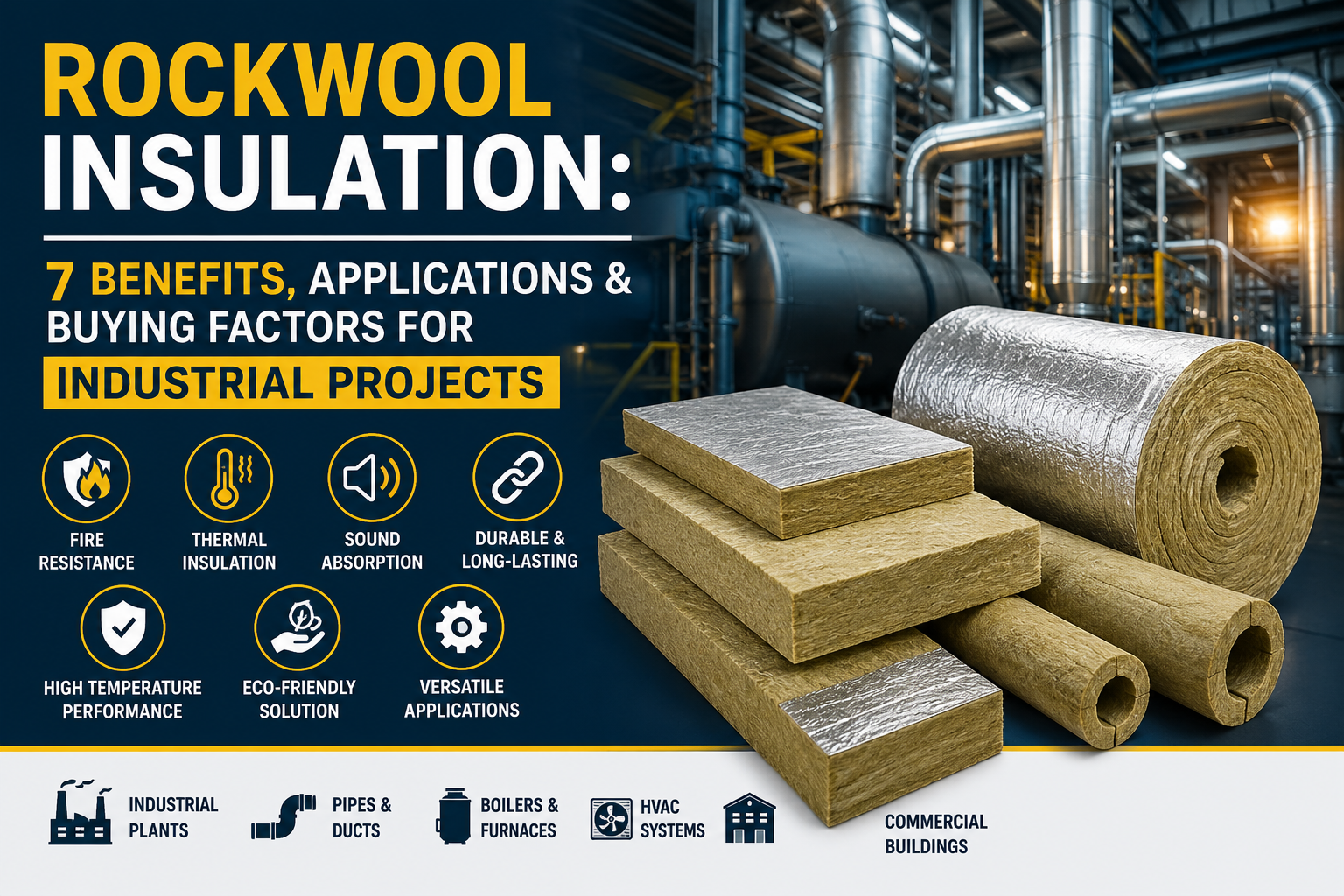
Rockwool insulation is an important insulation solution for industrial, commercial, HVAC, construction, and high-temperature applications where thermal performance, fire resistance, acoustic control, and durability are essential. Made primarily from mineral materials such as basalt, Rockwool is manufactured into fibrous insulation products that help reduce heat transfer while providing additional protection against fire and unwanted sound.
For factories, warehouses, commercial buildings, manufacturing plants, HVAC systems, boilers, furnaces, pipelines, and other industrial installations, selecting the right insulation material can have a direct impact on energy efficiency, safety, equipment performance, and operating costs.
If you are looking for a Rockwool Insulation Supplier in India, it is important to evaluate more than just the product price. Factors such as density, thickness, temperature requirements, application, product form, facing, installation conditions, and supplier reliability should all be considered before making a purchase.
This guide explains 7 key benefits of Rockwool insulation, its major industrial applications, and the important factors to consider when choosing a supplier.
What Is Rockwool Insulation?
Rockwool insulation, also known as mineral wool or stone wool insulation, is a fibrous insulation material manufactured from mineral or rock-based raw materials. The material is processed into fibres that form a structure capable of reducing heat transfer and absorbing sound.
Rockwool is particularly useful where a project requires a combination of thermal insulation, fire protection, and acoustic performance. Pararth Products offers Rockwool products in forms including building rolls, RB slabs, LRB mattresses, pipe insulation, Tuff Lamella, and Tuff Rigid Boards with options such as aluminium foil and Aluglass facing.
The appropriate form depends on the surface, operating temperature, required thickness, mechanical conditions, and installation method.
Why Is Rockwool Insulation Important for Industrial Projects?
Industrial facilities often contain equipment and systems that operate at elevated temperatures. Boilers, furnaces, hot pipelines, ducts, tanks, and process equipment can lose considerable heat if they are not properly insulated.
Industrial insulation can help regulate temperatures, improve energy efficiency, provide fire protection, and control noise. Rockwool is particularly suitable for demanding environments because its properties address several of these requirements simultaneously.
For an industrial project, the correct insulation solution can help:
- Reduce unwanted heat transfer
- Improve temperature control
- Support energy efficiency
- Reduce heat exposure around equipment
- Improve acoustic comfort
- Provide passive fire protection
- Protect insulated surfaces and systems
- Improve the overall performance of industrial installations
The exact performance depends on the product specification, thickness, density, installation quality, operating conditions, and system design.
7 Benefits of Rockwool Insulation
1. Excellent Thermal Insulation
One of the primary reasons industries use Rockwool is its ability to reduce heat transfer.
Industrial equipment such as hot pipes, boilers, furnaces, ducts, tanks, and process systems can operate at temperatures significantly different from the surrounding environment. Without suitable insulation, heat can escape from hot systems or enter temperature-controlled systems.
Rockwool’s fibrous structure creates resistance to heat transfer, helping maintain more stable temperatures.
This can be particularly useful for:
- Hot pipelines
- Boilers
- Furnaces
- HVAC systems
- Industrial ducts
- Tanks
- Process equipment
- Roof and wall systems
- Under-deck applications
Better thermal control can also contribute to improved energy efficiency when the insulation system is properly designed and installed.
2. High Fire Resistance
Fire safety is an important consideration for industrial and commercial construction.
Rockwool is a mineral-based insulation material and is widely used where non-combustibility and fire resistance are important design requirements. Rockwool Technical Insulation notes that stone wool products can withstand very high temperatures and are used for fire protection in industrial environments.
This makes Rockwool suitable for applications where fire performance is a major consideration, including:
- Industrial buildings
- Fire-rated walls
- Boilers
- Furnaces
- Manufacturing facilities
- HVAC systems
- Process areas
- Industrial partitions
- High-temperature installations
However, fire performance is not determined by the insulation alone. The complete assembly, product specification, installation method, facing, thickness, and applicable fire standards should be evaluated for the specific project.
3. Effective Sound Absorption
Industrial environments can generate significant noise from machinery, compressors, pumps, HVAC equipment, production lines, and other mechanical systems.
Rockwool’s fibrous structure can help absorb sound and reduce noise transmission when incorporated into an appropriately designed acoustic system.
This makes it useful for:
- Machine rooms
- HVAC rooms
- Industrial plants
- Generator rooms
- Equipment enclosures
- Acoustic partitions
- Commercial buildings
- Mechanical rooms
For facilities where employee comfort and noise management are important, Rockwool can provide both thermal and acoustic benefits.
4. Suitable for High-Temperature Applications
Many insulation materials are selected according to their temperature limitations. Industrial environments may involve hot pipes, boilers, furnaces, exhaust systems, and process equipment.
Rockwool is particularly useful for applications requiring resistance to elevated temperatures. Its mineral composition makes it suitable for various high-temperature insulation requirements.
Common high-temperature applications include:
- Furnace insulation
- Boiler insulation
- Hot pipe insulation
- Industrial equipment
- Process pipelines
- Heat-generating machinery
- Industrial ducts
The required product grade and thickness should always be selected according to the actual operating temperature and project specifications.
5. Durable and Long-Lasting
Industrial insulation is expected to perform for extended periods under demanding operating conditions.
Rockwool is an inorganic mineral-based material, and its resistance to rot and biological attack can make it suitable for long-term insulation applications. Pararth Products specifically describes its Rockwool products as resistant to rot and microorganisms and suitable for applications including pipe, hot, under-deck, over-deck, and acoustic insulation.
Durability can be influenced by:
- Correct product selection
- Proper thickness
- Installation quality
- Mechanical protection
- Moisture exposure
- Surface preparation
- Operating temperature
- Appropriate jacketing or facing
Therefore, choosing a suitable product is only one part of achieving long-term insulation performance.
6. Versatile Product Forms
Another advantage of Rockwool is the availability of different product forms for different applications.
Depending on the project, Rockwool may be supplied as:
- Building rolls
- Insulation slabs
- LRB mattresses
- Pipe insulation
- Lamella products
- Rigid boards
Pararth Products lists several of these Rockwool formats and also offers products with aluminium foil or Aluglass facing options.
Different forms make it possible to select insulation according to the shape and requirements of the application.
For example:
Pipe insulation can be used for cylindrical pipelines, while rigid boards or slabs may be more appropriate for walls, roofs, equipment, or other relatively flat surfaces.
7. Multiple Industrial and Building Applications
Rockwool is not limited to a single type of project.
Its combination of thermal, acoustic, and fire-resistant properties makes it suitable for various industrial and construction applications. Pararth Products lists applications such as under-deck insulation, over-deck insulation, acoustic insulation, hot and furnace insulation, and pipe insulation.
This versatility makes Rockwool a practical option for projects where multiple insulation requirements need to be addressed.
Major Applications of Rockwool Insulation
1. Pipe Insulation
Industrial pipelines may transport fluids or gases at high or low temperatures. Insulating these pipelines helps control heat transfer and maintain operating conditions.
Rockwool pipe insulation can be used for suitable hot-pipe applications where the product specification matches the operating requirements.
Applications include:
- Industrial process piping
- Hot water pipelines
- Steam-related systems
- HVAC piping
- Manufacturing plants
- Utility systems
Correct thickness and installation are important to achieve the desired thermal performance.
2. Boiler Insulation
Boilers generate substantial heat and require suitable insulation to reduce heat loss and improve safety around the equipment.
Rockwool can be used as part of a properly engineered boiler insulation system.
The insulation can help:
- Reduce heat loss
- Maintain operating temperatures
- Improve energy efficiency
- Reduce surface temperatures
- Improve workplace safety
3. Furnace and High-Heat Insulation
Industrial furnaces operate at elevated temperatures and require insulation materials specifically designed for the conditions.
Rockwool can be considered for appropriate furnace-related insulation applications where the temperature and product specifications are compatible.
Always confirm the maximum service temperature and system design before selecting the insulation.
4. HVAC Insulation
HVAC systems require insulation to help reduce unwanted heat transfer through ducts and piping.
Rockwool may be used for suitable HVAC applications, especially where thermal performance, acoustic control, and fire resistance are important.
Potential applications include:
- HVAC ducts
- Mechanical rooms
- Air-conditioning systems
- Ventilation systems
- HVAC equipment areas
The correct insulation type should be selected based on the system temperature, location, moisture exposure, fire requirements, and installation method.
5. Under-Deck Insulation
Industrial sheds and commercial buildings can experience significant heat gain through roofs and exposed structural surfaces.
Under-deck insulation can help reduce heat transfer between the roof structure and the internal environment.
Rockwool can be used for suitable under-deck systems where the product specification matches the design requirements.
This can be useful in:
- Industrial sheds
- Warehouses
- Manufacturing units
- Commercial buildings
- Workshops
- Large-span structures
6. Over-Deck Insulation
Over-deck insulation is another application where insulation is incorporated above or around the roof deck as part of the building envelope.
A properly designed roof insulation system can help improve thermal performance and indoor temperature control.
Rockwool products can be selected for suitable roof and deck applications based on the required load, thickness, thermal performance, moisture conditions, and installation system.
7. Acoustic Insulation
Factories and commercial buildings may require noise control because of machinery, HVAC equipment, generators, and other sources.
Rockwool can be incorporated into acoustic systems for:
- Sound-absorbing walls
- Partitions
- Equipment rooms
- HVAC rooms
- Industrial enclosures
- Commercial spaces
The final acoustic performance depends on the complete wall, ceiling, enclosure, or partition system not simply the insulation material.
How to Choose the Right Rockwool Insulation for an Industrial Project
Selecting the correct Rockwool product requires more than choosing the cheapest available option.
Consider the following factors before placing an order.
1. Application
First identify exactly where the insulation will be installed.
Is it for:
- Pipes?
- Ducts?
- Boilers?
- Furnaces?
- Walls?
- Roofs?
- Under-deck areas?
- Acoustic applications?
- Industrial equipment?
The application determines the most suitable product form.
2. Operating Temperature
Temperature is one of the most important selection criteria for industrial insulation.
Before purchasing, determine:
- Normal operating temperature
- Maximum operating temperature
- Minimum operating temperature
- Temperature fluctuations
- Ambient conditions
The selected product should be appropriate for the actual operating environment.
3. Required Thickness
Insulation thickness directly affects thermal performance.
The correct thickness should be determined based on factors such as:
- Operating temperature
- Desired surface temperature
- Energy-loss requirements
- Ambient temperature
- Pipe or equipment dimensions
- Applicable standards
- Project specifications
Avoid selecting thickness based only on price or appearance.
4. Density
Different applications may require different Rockwool densities.
Density selection can depend on:
- Mechanical requirements
- Temperature
- Location
- Compression resistance
- Acoustic requirements
- Installation method
A professional insulation supplier can help match the product specification to the application.
5. Facing and Jacketing Requirements
Some applications may require additional protection over the insulation.
Depending on the installation, options can include suitable foil facings, protective coverings, or external jacketing.
Pararth Products offers Rockwool products with facing options including aluminium foil and Aluglass for specified products.
The facing should be selected according to the environmental and mechanical conditions of the installation.
6. Moisture Exposure
Although Rockwool has useful moisture-related properties, insulation systems must still be designed appropriately for the environment.
Projects should consider:
- Humidity
- Rain exposure
- Condensation
- Water leakage
- Outdoor installation
- Vapour control requirements
Poor moisture management can reduce the performance of an insulation system regardless of the insulation material selected.
7. Supplier Experience and Product Availability
The supplier is an important part of an industrial insulation project.
Before choosing a Rockwool Insulation Dealer in Ahmedabad, check whether the supplier can provide:
- Required product type
- Required thickness
- Required density
- Suitable facing
- Consistent product quality
- Project quantities
- Technical information
- Timely delivery
- Application guidance
For large industrial projects, reliable supply can be just as important as product selection.
Rockwool Insulation vs Other Insulation Materials
Rockwool is one of several insulation solutions available for industrial and commercial projects.
The right material depends on the application.
Rockwool
Best suited for applications where:
- Fire resistance is important
- High-temperature performance is required
- Acoustic control is needed
- Durable mineral insulation is preferred
- Industrial applications require robust insulation
Glasswool
Glasswool is commonly selected for thermal and acoustic insulation in buildings, HVAC systems, and industrial applications.
It can be useful where lightweight insulation and acoustic performance are important.
Nitrile Rubber Insulation
Nitrile rubber insulation is commonly used in HVAC and refrigeration systems where flexibility and condensation control are important.
It is particularly useful for chilled-water piping and air-conditioning applications.
PUF Panels
PUF panels are different from conventional fibrous insulation products and are widely used for insulated building envelopes, cold rooms, warehouses, and other controlled-temperature structures.
Therefore, the question is not simply which insulation material is “best.” The better question is:
Which insulation material is best suited to the project’s temperature, fire, acoustic, moisture, structural, and installation requirements?
Why Choose a Reliable Rockwool Insulation Supplier?
For industrial projects, insulation is often installed across large areas or extensive piping networks. A mistake in product selection can increase material waste, installation costs, maintenance requirements, and energy losses.
A reliable supplier should be able to understand the project requirements and provide appropriate product options.
Pararth Products Pvt. Ltd. supplies insulation products including Rockwool, Glasswool, Nitrile Rubber, XLPE and other insulation solutions. Its website also lists services such as HVAC insulation work, under-deck insulation, false-ceiling insulation, and pre-insulated duct fabrication.
For customers searching for a Rockwool Insulation Supplier in India, Pararth Products provides Rockwool insulation in multiple product formats for different applications.
Rockwool Insulation Supplier in India
Ahmedabad has a strong base of manufacturing facilities, industrial units, warehouses, commercial properties, HVAC contractors, engineering companies, and construction projects. These applications often require dependable insulation materials for temperature management, fire protection, sound control, and energy efficiency.
Choosing a local Rockwool Insulation Supplier in Indiacan make project procurement easier by providing access to suitable products and support for local requirements.
Pararth Products Pvt. Ltd. is based in Ahmedabad and supplies insulation products for industrial and commercial applications. Its Rockwool range includes building rolls, slabs, mattresses, pipe insulation, lamella products, and rigid boards, subject to product availability and project requirements.
Rockwool Insulation Supplier for Industrial Applications
Industrial projects often have different requirements from residential construction.
A manufacturing plant may require insulation for hot pipelines, while an HVAC contractor may require duct insulation. A warehouse may need roof insulation, while a machinery room may require both thermal and acoustic control.
This is why choosing an insulation supplier with a broad product range can simplify procurement.
Before ordering, provide the supplier with details such as:
- Application type
- Surface dimensions
- Operating temperature
- Required thickness
- Required density
- Indoor or outdoor installation
- Moisture conditions
- Fire requirements
- Quantity required
- Project location
- Installation method
This allows the supplier to recommend a more appropriate product.
7 Questions to Ask Before Buying Rockwool Insulation
Before finalizing a purchase, ask the supplier:
1. Which Rockwool product is suitable for my application?
The correct product depends on whether the material is required for pipes, ducts, roofs, walls, equipment, furnaces, or acoustic applications.
2. What thickness should I use?
Ask for a recommendation based on operating temperature and project requirements rather than selecting thickness solely on price.
3. What density is required?
Density can affect the suitability of the product for particular applications.
4. Is facing required?
Ask whether aluminium foil, Aluglass, or another protective system is appropriate for the installation.
5. What temperature range can the product handle?
This is particularly important for boilers, furnaces, hot pipes, and other high-temperature applications.
6. How should the insulation be installed?
Correct installation is essential for achieving the expected performance.
7. Can the supplier provide the required quantity and delivery schedule?
Large projects need consistent material availability and reliable delivery.
Conclusion
Rockwool insulation is a versatile solution for industrial and commercial applications where thermal insulation, fire resistance, acoustic performance, durability, and high-temperature suitability are important.
Its applications range from pipe and boiler insulation to HVAC systems, under-deck insulation, over-deck insulation, acoustic applications, furnaces, and industrial equipment.
However, selecting the right Rockwool product requires careful consideration of the application, operating temperature, thickness, density, facing, moisture exposure, installation method, and project requirements.
For businesses searching for a Rockwool Insulation Supplier in Ahmedabad, Pararth Products Pvt. Ltd. offers a range of Rockwool insulation products and other insulation solutions for different industrial and commercial requirements.
The company can also be considered for related insulation requirements, including Glasswool, Nitrile Rubber, XLPE, and other insulation materials.
Frequently Asked Questions About Rockwool Insulation
Is Rockwool insulation suitable for industrial applications?
Yes. Rockwool is used for various industrial applications including piping, equipment, HVAC systems, boilers, furnaces, roofs, walls, and acoustic systems. The appropriate product should be selected according to the application and operating conditions.
Is Rockwool insulation fire resistant?
Rockwool is a mineral-based insulation material known for strong fire-resistant performance. Specific fire ratings and performance should be verified against the exact product and complete construction assembly.
Where can Rockwool insulation be used?
Rockwool can be used for pipe insulation, HVAC systems, under-deck and over-deck insulation, acoustic applications, industrial equipment, boilers, furnaces, walls, and other suitable applications.
How do I choose the correct Rockwool thickness?
The required thickness depends on operating temperature, desired thermal performance, surface temperature requirements, ambient conditions, application, and project specifications. A qualified insulation professional should determine the appropriate thickness.
What is the difference between Rockwool and Glasswool?
Both are mineral-fibre insulation materials, but their characteristics and suitable applications can differ. Rockwool is often selected where higher fire resistance, density, acoustic performance, or high-temperature capability is important, while Glasswool is widely used for lightweight thermal and acoustic insulation.
How can I find a Rockwool Insulation Supplier in Ahmedabad?
Look for a supplier that offers suitable product formats, specifications, consistent availability, technical information, and delivery support. Pararth Products Pvt. Ltd. supplies Rockwool insulation products from Ahmedabad for various applications.
What other insulation products are available from Pararth Products?
Pararth Products lists Rockwool, Glasswool, Nitrile Rubber, XLPE, Air Bubble insulation, PIR ducts, PUF panels, polycarbonate sheets, and other products in its range.