
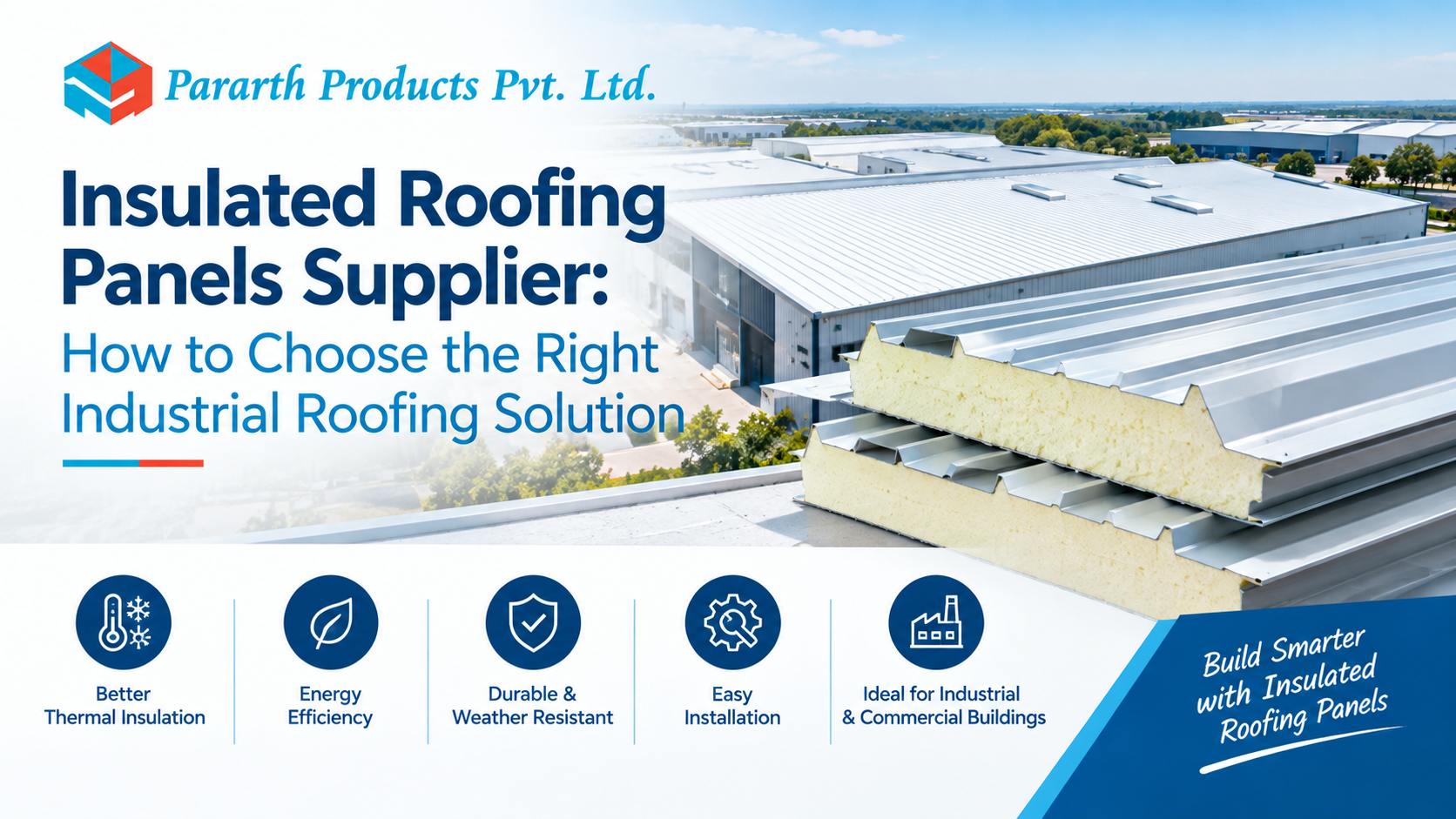
Choosing the right roofing system is an important decision for industrial buildings, warehouses, factories, commercial facilities, and manufacturing units. A suitable roof helps protect the building from external weather conditions while supporting indoor comfort, operational efficiency, and long-term building performance. For many projects, insulated roofing panels are an option worth considering because they combine roofing sheets with an insulating core in a single panel system.
However, selecting the right product involves more than comparing prices. Buyers must consider the building’s purpose, insulation requirements, panel thickness, material specifications, installation method, durability, and supplier capabilities.
If you are searching for an insulated roofing panels supplier, understanding these factors can help you make a more informed purchasing decision. In this guide, we explain the key benefits of insulated roofing panels, the available panel types, the specifications buyers should review, and how to evaluate a supplier for your industrial project.
What Are Insulated Roofing Panels?
Insulated roofing panels are building components designed to provide a roof covering and thermal insulation within a combined panel structure. Many systems use metal facings with an insulating core between them. The exact construction depends on the panel type, manufacturer, and intended application.
These panels are commonly considered for industrial sheds, warehouses, manufacturing facilities, commercial buildings, and certain temperature-controlled environments.
Compared with a conventional single-skin metal roof, an insulated panel system can help reduce heat transfer through the roof when properly selected and installed. Actual performance depends on the insulation material, thickness, panel joints, thermal bridging, air leakage, and overall building design.
For this reason, buyers should evaluate insulated roofing panels according to their project’s technical requirements rather than choosing a product based on appearance alone.
Why Are Insulated Roofing Panels Used in Industrial Buildings?
Industrial buildings often have large roof areas exposed to sunlight, outdoor temperature changes, wind, and rain. The roof can have a significant influence on the indoor environment, particularly in facilities with machinery, employees, stored goods, or temperature-sensitive processes.
Insulated roofing panels may offer several advantages when the right system is selected.
1. Improved Thermal Insulation
One of the main reasons for choosing insulated roofing panels is their ability to reduce heat transfer through the roof.
During hot weather, a properly designed insulated roof can help limit the amount of external heat entering a building. In cooler conditions, insulation can help reduce heat loss.
The actual improvement depends on the insulation core, panel thickness, installation quality, and other building components. Insulation should therefore be selected according to the required thermal performance.
2. Potential Energy Savings
Buildings that use mechanical cooling or heating may benefit from a roof system that reduces unwanted heat transfer.
By improving the building envelope, insulated panels can help reduce heating or cooling demand under suitable conditions. The actual savings depend on factors such as climate, building occupancy, operating hours, ventilation, equipment, and the performance of the existing roof.
Businesses should assess energy performance as part of the overall building design rather than assuming a fixed percentage of savings.
3. Efficient Construction
Many insulated roofing panel systems are manufactured in standard or project-specific dimensions and installed as integrated roof components.
Depending on the panel design and building requirements, this can simplify the roofing assembly by combining the external covering and insulation into one product. Installation time and labour requirements will depend on the roof layout, access, fixing system, and project complexity.
4. Weather Protection
The outer facing of a roofing panel is designed to provide a protective roof surface. Properly specified panels, compatible fasteners, appropriate flashing, and correctly sealed joints help protect the building from rain and wind.
Roof slope, drainage, joint design, and installation workmanship remain essential. Even a high-quality panel may perform poorly if water can enter through poorly sealed joints or incorrectly detailed roof penetrations.
5. A More Comfortable Indoor Environment
Insulation can help moderate temperature fluctuations inside an industrial building. This may improve working conditions and support processes that require more stable indoor temperatures.
For facilities storing temperature-sensitive products, the entire building envelope must be designed around the required conditions. Roofing insulation alone does not replace suitable wall insulation, doors, ventilation, or dedicated temperature-control equipment.
Types of Insulated Roofing Panels
Different insulation materials have different characteristics. The right option depends on the project’s thermal, structural, fire-safety, moisture, and budget requirements.
1. PUF or Polyurethane Foam Roofing Panels
Polyurethane foam panels are used in certain building envelope systems because they can provide effective thermal insulation at a given thickness.
When considering PUF roofing panels, buyers should check the panel’s declared thermal performance, facing materials, joint details, fire-performance documentation, and intended use.
The abbreviation PUF is used broadly in the market, so confirm the exact foam type and product specification before ordering.
2. PIR Insulated Roofing Panels
Polyisocyanurate, commonly called PIR, is a rigid foam insulation material used in various insulated building panel systems.
PIR panels may be considered where thermal performance and specific fire-performance characteristics are important. However, fire performance depends on the complete panel assembly, its facings, thickness, joints, and relevant test results.
Always verify that the proposed panel meets the applicable building regulations and project specifications.
3. EPS Insulated Roofing Panels
Expanded polystyrene, or EPS, is another insulation material used in some roofing and sandwich panel systems.
EPS panels may be considered for projects with suitable thermal requirements and budget constraints. Buyers should evaluate thermal performance, moisture exposure, fire classification, and the manufacturer’s recommendations before selecting this option.
4. Rockwool or Mineral Wool Roofing Panels
Mineral wool insulated panels use a mineral-fibre core. They may be selected for projects where fire performance, acoustic characteristics, or specific industrial requirements are important.
The exact fire resistance, acoustic performance, and thermal characteristics depend on the tested panel system. Ask for relevant technical documentation instead of relying only on the insulation material’s general properties.
Important: These panel types are not interchangeable in every application. Consult the project’s designer, supplier, and relevant technical documentation to identify a suitable system.
Important Specifications to Check Before Buying
Before contacting a supplier, prepare a clear list of your project requirements. This helps ensure that quotations can be compared accurately.
1. Panel Thickness
Insulated roofing panels are available in different thicknesses depending on the product range.
The appropriate thickness depends on the required thermal performance, climate, building use, and applicable project standards. A thicker panel does not automatically make a complete roof system suitable if joints, fasteners, or other components create significant thermal bridges.
2. Insulation Core
Confirm whether the panel uses PUF, PIR, EPS, mineral wool, or another specified material.
Check the declared thermal conductivity or thermal resistance, as applicable, and verify that the material meets the project’s performance requirements.
3. Metal Facing and Coating
For metal-faced panels, review the facing material, metal thickness, coating system, corrosion protection, and colour requirements.
The suitability of a facing depends on the environment. Buildings exposed to industrial pollutants, coastal conditions, chemicals, or other aggressive environments may require specific corrosion-protection measures.
4. Panel Width and Length
Panel dimensions affect roof planning, joint placement, transportation, handling, and installation.
Provide the roof layout and required dimensions when requesting a quotation. Confirm maximum available panel lengths, transport restrictions, and handling requirements before finalizing the order.
5. Structural Requirements
Roof panels must be suitable for the project’s structural design. Relevant factors can include wind uplift, imposed loads, support spacing, panel span, fixing details, and maintenance access.
Do not choose a panel solely on insulation thickness. The selected system should be checked against the applicable structural design requirements by a qualified professional.
6. Fire and Building Compliance
Industrial roofing projects may have specific fire-safety and building-code requirements.
Ask for relevant fire-test reports, classifications, certifications, and technical datasheets for the complete panel assembly. Confirm that the documentation applies to the proposed product and installation configuration.
How to Choose the Right Insulated Roofing Panels Supplier
Choosing a supplier is an important part of procurement because the product specification, supply schedule, documentation, and delivery arrangements can affect the success of a project.
When evaluating an insulated roofing panel supplier, consider the following points.
1. Confirm the Available Product Range
Ask which panel types, insulation cores, thicknesses, facings, and dimensions are available.
Not every supplier offers every panel configuration. Confirm that the proposed products match your requirements before proceeding to detailed price comparisons.
2. Review Technical Documentation
A professional purchasing decision should be supported by clear product information.
Request the technical datasheet, declared thermal performance, structural information where applicable, installation guidance, warranty conditions, and relevant compliance documentation.
The documents should correspond to the exact product being quoted.
3. Compare Quotations on an Equal Basis
Request quotations that specify the same panel thickness, insulation core, facing material, dimensions, coating, accessories, and quantity.
Check whether the quotation includes fasteners, flashings, ridge components, sealants, freight, taxes, and installation. These items may be quoted separately.
Comparing equivalent specifications makes it easier to understand the actual commercial difference between offers.
4. Confirm Supply and Delivery Arrangements
Industrial construction schedules can be affected by material delays.
Before placing an order, confirm stock or production availability, lead time, delivery location, packaging, unloading requirements, and any limitations related to transporting long panels.
For large projects, coordinate deliveries with the construction schedule and available site storage.
5. Understand Warranty and After-Sales Support
Review the warranty terms for the panel, coating, and other supplied components. Confirm the coverage period, exclusions, maintenance requirements, and process for handling product defects.
Where installation is supplied separately, clarify who is responsible for workmanship and the roof’s completed performance.
6. Assess Communication and Project Coordination
A suitable supplier should communicate clearly about specifications, lead times, commercial terms, and product limitations.
Providing an accurate project brief at the beginning helps reduce misunderstandings and allows the supplier to determine whether the requested panel is available and appropriate for further evaluation.
What Factors Affect Insulated Roofing Panels Price?
The cost of insulated roofing panels varies depending on the selected product and the project’s requirements. There is no single price that applies to every panel type.
Common cost factors include:
- Insulation material and core thickness
- Metal facing thickness and coating
- Panel dimensions and order quantity
- Profile and joint configuration
- Required accessories and flashings
- Fire-performance or other project-specific requirements
- Transportation, unloading, and installation
- Taxes and commercial terms
When preparing a budget, calculate the required roof coverage and account for overlap, cutting waste, ridge details, roof edges, openings, and other design elements.
Request an itemized quotation and compare the total installed cost where installation is included. This provides a more useful comparison than evaluating the panel price alone.
Applications of Insulated Roofing Panels
Insulated roofing panels are considered for many types of buildings, subject to the selected system’s specifications.
Industrial Sheds and Factories
Factories may use insulated roof systems to help manage heat transfer and protect internal operations. Panel selection should account for the building’s operating environment and structural design.
Warehouses and Distribution Centres
Warehouses often have extensive roof areas. Suitable insulation can help moderate indoor temperature conditions, particularly when combined with an appropriately designed building envelope.
Commercial Buildings
Certain commercial facilities use insulated roofing systems to support thermal comfort and energy-performance objectives. Architectural requirements, roof drainage, and local regulations should be considered.
Cold Storage and Temperature-Controlled Facilities
Temperature-controlled buildings require careful control of heat transfer, air leakage, vapour movement, and thermal bridges.
Roof panels for these applications must be selected as part of a complete envelope system, with appropriate joint details and moisture-control measures. A general-purpose insulated roof panel should not be assumed suitable for cold storage without technical verification.
Why Consider Pararth Products Pvt. Ltd.?
Pararth Products Pvt. Ltd. operates in the insulation and HVAC-related products sector. Businesses evaluating industrial insulation materials can visit the company’s website to explore its product range and contact the team with their requirements.
If you are considering insulated roofing panels for a project, confirm whether the company supplies the specific panel type you require before proceeding. Share your building dimensions, intended application, insulation requirements, and delivery location so that product availability and suitability can be discussed.
A clear enquiry should include the desired panel type, thickness, facing specifications, approximate quantity, project location, and required delivery schedule.
Visit the official website:https://pararthproducts.com/
Frequently Asked Questions
1. What are insulated roofing panels used for?
Insulated roofing panels are used in suitable industrial, commercial, and other buildings to provide a roof covering with integrated thermal insulation. Applications depend on the panel design and its technical specifications.
2. How do I choose an insulated roofing panels supplier?
Review the supplier’s available products, technical documentation, quotation details, delivery capabilities, warranty conditions, and ability to meet the project’s specifications. Compare equivalent products rather than price alone.
3. Which insulated roofing panel is best for a factory?
The appropriate panel depends on the factory’s thermal requirements, roof design, structural loads, moisture exposure, fire-safety requirements, and budget. A qualified designer should verify the proposed system against project requirements.
4. What thickness should I choose for insulated roofing panels?
The required thickness depends on the target thermal performance, insulation material, climate, building use, and relevant standards. Consult the product’s technical data and project designer before making a selection.
5. Are insulated roofing panels suitable for warehouses?
They can be suitable for many warehouses when the selected panel meets the building’s structural, thermal, weatherproofing, and fire-safety requirements. The specific application should determine the panel design.
6. What affects the price of insulated roofing panels?
Price depends on the insulation core, thickness, facings, coating, dimensions, quantity, accessories, transportation, and installation requirements. Ask for an itemized quotation based on your project specifications.
7. What information is needed for a roofing panel quotation?
Provide the roof dimensions or drawings, required panel type, insulation thickness, facing specifications, estimated quantity, site location, delivery schedule, and any relevant fire or structural requirements.
8. Does Pararth Products Pvt. Ltd. supply insulated roofing panels?
Contact Pararth Products Pvt. Ltd. through its official website to confirm the current product range, availability, technical specifications, and quotation process.
Conclusion
Selecting the right industrial roof requires careful consideration of thermal performance, panel construction, structural requirements, weather protection, fire safety, supply arrangements, and total project cost.
Before making a purchase, define your project requirements, compare technically equivalent quotations, review the relevant documentation, and confirm delivery schedules. Taking these steps can help you choose a roofing system that meets your building’s needs and supports long-term performance.
If you are researching an insulated roofing panels supplier, start with a clear specification and discuss the available options with a supplier that can address your project’s requirements.
Contact Pararth Products Pvt. Ltd. to enquire about its insulation-related products and discuss your industrial material requirements.