
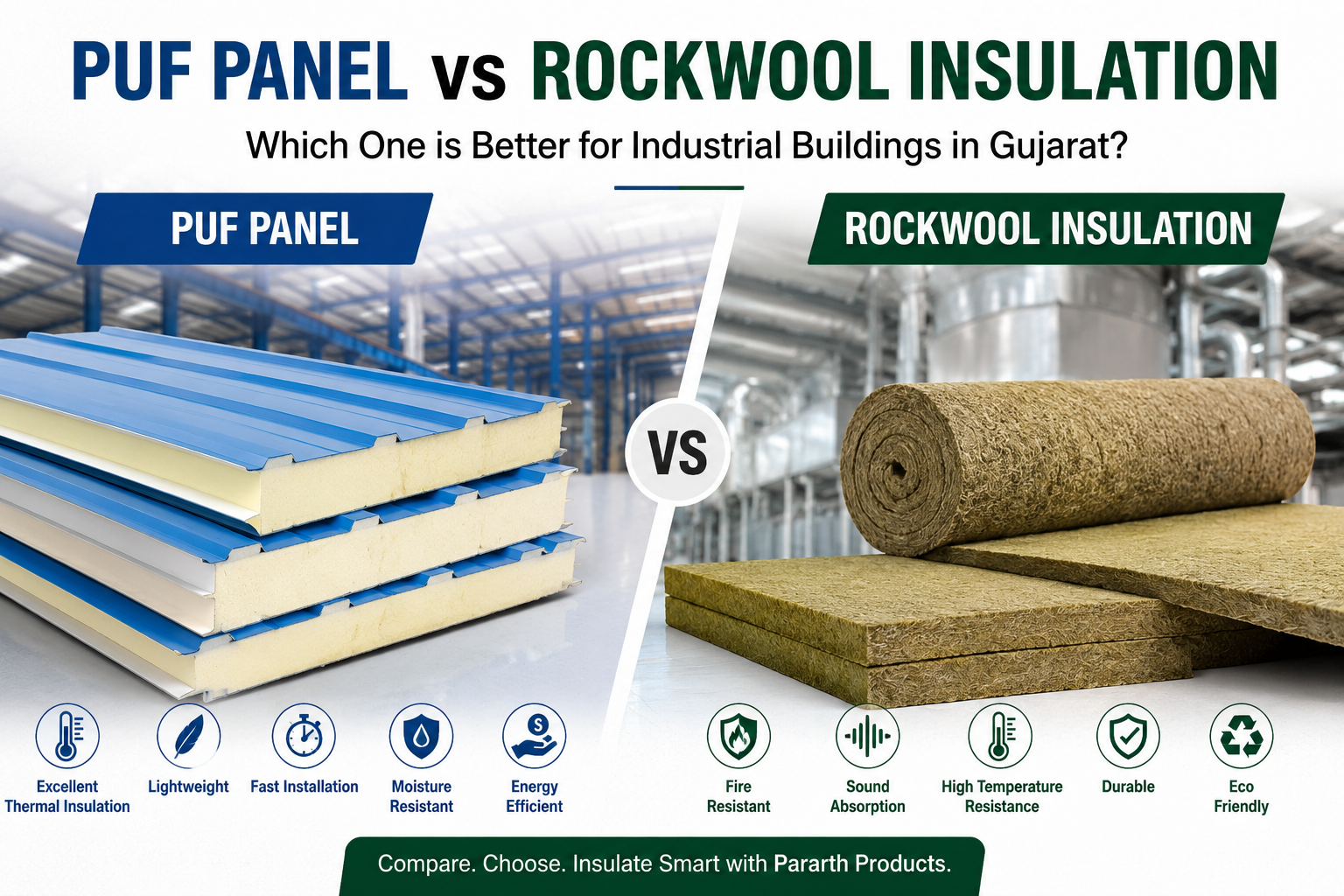
Industrial buildings in Gujarat are exposed to high temperatures, intense sunlight, dust, humidity in coastal regions, and demanding operating conditions. Whether you are constructing a warehouse, cold storage facility, manufacturing plant, food processing unit, pharmaceutical facility, or commercial building, selecting the right insulation material is one of the most important decisions for long-term energy savings and operational efficiency.
Among the most popular insulation solutions available today are PUF Panels and Rockwool Insulation. Both materials offer excellent insulation properties, but they serve different purposes depending on your project’s requirements.
In this detailed guide, we’ll compare PUF Panels and Rockwool Insulation based on thermal performance, fire resistance, durability, installation, maintenance, applications, and cost, helping you make an informed decision for your industrial project in Gujarat.
What Are PUF Panels?
PUF (Polyurethane Foam) Panels are factory-manufactured insulated sandwich panels consisting of a high-density polyurethane foam core bonded between two durable metal sheets. These panels are widely used in industrial and commercial construction because they provide outstanding thermal insulation while being lightweight and easy to install.
PUF panels have become a preferred choice for industries looking to reduce energy consumption and speed up construction. Their excellent insulation performance helps maintain stable indoor temperatures, making them ideal for temperature-controlled environments.
Common Applications of PUF Panels
- Industrial sheds
- Warehouses
- Cold storage facilities
- Food processing plants
- Pharmaceutical industries
- Clean rooms
- Commercial buildings
- Modular offices
- Portable cabins
- Prefabricated structures
What Is Rockwool Insulation?
Rockwool insulation, also known as mineral wool insulation, is manufactured from natural volcanic rock and recycled materials. The raw materials are melted at extremely high temperatures and spun into fine fibers, creating a highly durable insulation product with exceptional fire resistance.
Rockwool is widely used where fire safety, acoustic insulation, and high-temperature resistance are major priorities.
Common Applications of Rockwool
- HVAC duct insulation
- Industrial furnaces
- Boilers
- Power plants
- Petrochemical plants
- Acoustic wall insulation
- False ceilings
- Metal buildings
- Industrial piping
- Fire-rated walls
PUF Panel vs Rockwool Insulation: Quick Comparison
| Feature | PUF Panel | Rockwool Insulation |
|---|---|---|
| Thermal Insulation | Excellent | Very Good |
| Fire Resistance | Moderate to High (depending on grade) | Excellent |
| Weight | Lightweight | Heavier |
| Installation | Fast and easy | Requires skilled installation |
| Water Resistance | Excellent | Good with proper protection |
| Acoustic Performance | Moderate | Excellent |
| Energy Efficiency | Excellent | Good |
| Maintenance | Very Low | Low |
| Best For | Buildings and roofing | Fire protection and HVAC |
Thermal Insulation Performance
When it comes to reducing heat transfer, PUF panels outperform many traditional insulation materials. Their closed-cell foam structure provides excellent thermal resistance, allowing buildings to remain cooler during Gujarat’s extremely hot summers.
This results in:
- Lower indoor temperatures
- Reduced air conditioning costs
- Better employee comfort
- Improved productivity
- Lower electricity bills
Rockwool also provides effective thermal insulation, especially in industrial environments where high operating temperatures are common. However, its thermal conductivity is generally higher than that of PUF panels, meaning thicker insulation may be required to achieve similar thermal performance.
Fire Resistance
Fire safety is a critical consideration in industrial buildings.
Rockwool is naturally non-combustible and can withstand temperatures exceeding 1000°C without melting. This makes it an excellent choice for industries where fire protection is a primary concern.
PUF panels are available in different grades, including fire-retardant variants. While these panels offer improved fire performance, they are not inherently non-combustible like Rockwool.
If your facility has strict fire safety regulations or operates in high-temperature environments, Rockwool is often the preferred solution.
Energy Efficiency
Electricity costs continue to rise across India, making energy-efficient building materials more important than ever.
PUF panels significantly reduce heat transfer through roofs and walls, allowing HVAC systems to operate more efficiently. Many industrial facilities experience noticeable reductions in cooling expenses after installing insulated PUF panels.
For warehouses, cold storage units, pharmaceutical facilities, and food processing plants, PUF panels can contribute to substantial long-term energy savings.
Rockwool also improves energy efficiency but is generally selected when fire resistance and sound insulation are equally important.
Moisture Resistance
Industrial buildings often face moisture issues due to rainfall, humidity, and condensation.
PUF panels feature a closed-cell foam structure that resists water absorption, reducing the risk of mold, corrosion, and insulation failure.
Rockwool fibers themselves resist moisture, but the material can lose performance if exposed to prolonged water ingress without appropriate protective cladding.
Acoustic Performance
Noise control is essential in manufacturing plants, factories, commercial buildings, and HVAC systems.
Rockwool’s fibrous structure absorbs sound waves exceptionally well, making it one of the best insulation materials for reducing noise transmission.
Applications include:
- Generator rooms
- Industrial machinery
- HVAC ducts
- Recording rooms
- Commercial buildings
- Conference halls
PUF panels provide some sound insulation but are primarily designed for thermal efficiency rather than acoustic control.
Installation Speed
Construction timelines directly impact project costs.
PUF panels are prefabricated and manufactured to precise dimensions, enabling rapid installation with minimal labor. Their lightweight design simplifies handling and reduces construction time.
Rockwool insulation generally requires additional framing, support systems, and protective coverings, increasing installation time.
For projects with tight deadlines, PUF panels offer a clear advantage.
Durability
Both insulation materials are highly durable when installed correctly.
PUF panels maintain their structural integrity for many years with minimal maintenance. They resist corrosion, moisture, and weathering when manufactured with quality metal facings.
Rockwool also offers excellent longevity and retains its insulating properties under demanding industrial conditions.
Routine inspections and proper installation help maximize the lifespan of both systems.
Cost Comparison
Initial project costs vary depending on thickness, specifications, and installation requirements.
PUF panels may involve a higher upfront investment, but they often reduce overall construction costs by combining insulation, structural support, and finished surfaces into a single product.
Rockwool insulation may have lower material costs for certain applications, but installation expenses can be higher due to additional framing and protective layers.
When evaluating total lifecycle costs, energy savings and maintenance requirements should also be considered.
Best Applications for PUF Panels
PUF panels are ideal for:
- Cold storage facilities
- Warehouses
- Industrial sheds
- Pharmaceutical units
- Clean rooms
- Food processing plants
- Commercial buildings
- Modular offices
- Prefabricated structures
- Roofing systems
Best Applications for Rockwool Insulation
Rockwool insulation is recommended for:
- Fire-rated walls
- HVAC duct insulation
- Industrial furnaces
- Boiler insulation
- High-temperature process equipment
- Acoustic wall systems
- False ceilings
- Pipe insulation
- Petrochemical facilities
- Power plants
Which Insulation Is Better for Gujarat’s Climate?
Gujarat experiences prolonged summers with temperatures often exceeding 40°C. Industrial buildings require insulation that minimizes heat gain, reduces cooling loads, and improves indoor comfort.
For warehouses, manufacturing plants, logistics centers, pharmaceutical facilities, and commercial buildings, PUF panels generally provide the best balance of thermal performance, energy efficiency, and construction speed.
If your project prioritizes fire resistance, acoustic insulation, or high-temperature industrial equipment, Rockwool remains an outstanding solution.
In many modern industrial projects, both materials are used together. For example, PUF panels may be installed for roofs and walls, while Rockwool is applied to HVAC ducts, piping, and fire-rated partitions to achieve the benefits of both systems.
Frequently Asked Questions
Which insulation is better for industrial roofing?
PUF panels are widely preferred for industrial roofing because they provide excellent thermal insulation, reduce heat gain, and help lower energy costs.
Are PUF panels waterproof?
Yes. The closed-cell polyurethane foam core offers excellent resistance to moisture and water absorption.
Is Rockwool fireproof?
Rockwool is non-combustible and provides exceptional fire resistance, making it suitable for applications requiring enhanced fire safety.
Which insulation lasts longer?
Both PUF panels and Rockwool insulation offer long service lives when installed correctly and maintained appropriately.
Can PUF panels and Rockwool be used together?
Yes. Many industrial buildings combine PUF panels for roofs and walls with Rockwool insulation for HVAC systems, piping, and fire-rated areas to achieve optimal performance.
Final Verdict
Choosing between PUF panels and Rockwool insulation depends on your project’s specific requirements.
If your priority is thermal insulation, energy efficiency, lightweight construction, and faster installation, PUF panels are an excellent choice for industrial buildings in Gujarat.
If fire resistance, sound insulation, and high-temperature performance are your primary concerns, Rockwool insulation is the better solution.
For many industrial facilities, a combination of both materials delivers the best overall performance, ensuring energy efficiency, fire safety, and long-term durability.
Looking for Reliable Insulation Solutions in Gujarat?
At Pararth Products, we supply high-quality PUF panels, Rockwool insulation, Glasswool insulation, XLPE insulation, nitrile rubber insulation, air bubble insulation, PIR ducts, polycarbonate sheets, and a wide range of industrial insulation materials for commercial and industrial projects.
Whether you need insulation for a warehouse, factory, cold storage facility, HVAC system, or industrial roofing, our experienced team can help you choose the right solution for your project.
Contact Pararth Products today to discuss your insulation requirements and receive expert guidance tailored to your building needs.