
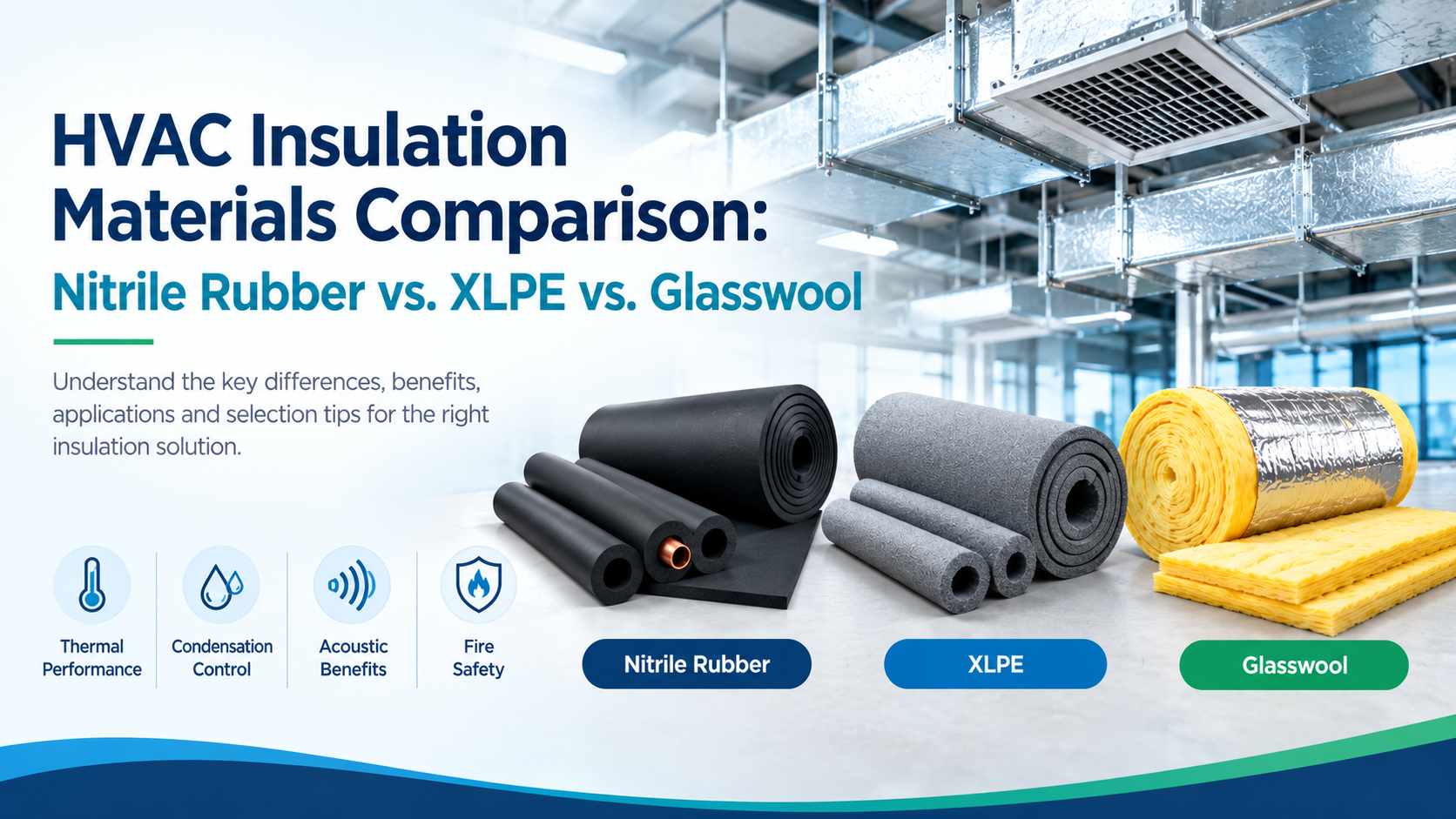
Choosing the right HVAC insulation material is essential for maintaining indoor comfort, reducing unwanted heat transfer, controlling condensation, and improving the performance of heating, ventilation, and air conditioning systems. The right insulation can also help protect pipes and ducts while supporting efficient operation in commercial and industrial buildings.
However, not every insulation material is suitable for every HVAC application. Nitrile rubber, XLPE (cross-linked polyethylene), and Glasswool each offer different advantages depending on the operating temperature, moisture exposure, installation environment, acoustic requirements, and project specifications.
In this guide, we compare Nitrile Rubber vs. XLPE vs. Glasswool to help facility managers, HVAC contractors, architects, consultants, and industrial buyers make an informed decision.
What Is HVAC Insulation?
HVAC insulation is a protective material installed around air-conditioning ducts, chilled-water pipes, refrigerant lines, and other HVAC components to reduce unwanted heat transfer.
Depending on the application, insulation may help:
- Reduce heat gain or heat loss through ducts and pipes.
- Control surface condensation on cold HVAC components.
- Support energy-efficient heating and cooling.
- Improve indoor temperature stability.
- Reduce noise transmission when an appropriate acoustic insulation system is used.
- Protect HVAC components from temperature fluctuations and environmental exposure.
The performance of an insulation system depends on more than the material alone. Thickness, thermal conductivity, vapour resistance, joint sealing, installation quality, and operating conditions all influence the final result.
1. Nitrile Rubber Insulation: Best for Condensation Control
Nitrile rubber insulation, commonly supplied as flexible closed-cell foam, is widely used for chilled-water piping, refrigeration lines, air-conditioning ducts, and other HVAC applications.
Its closed-cell structure helps resist water-vapour penetration. When the correct thickness is selected and all joints and terminations are properly sealed, it can help reduce the risk of condensation on cold surfaces.
Key benefits of Nitrile Rubber
- Condensation control: Its closed-cell structure can provide effective vapour resistance.
- Flexible installation: Flexible sheets and tubes can fit around pipes, bends, and equipment.
- Thermal insulation: Helps limit unwanted heat gain or heat loss.
- Space-efficient installation: Often suitable for compact plant rooms and congested service areas.
- Maintenance convenience: Flexible sections can be practical to install around accessible HVAC components.
Common applications
- Chilled-water pipes
- Refrigerant and suction lines
- Air-conditioning ductwork
- HVAC equipment and fittings
- Commercial building air-conditioning systems
What should buyers consider?
Nitrile rubber products differ in thermal conductivity, vapour resistance, temperature limits, fire performance, and thickness. Check the manufacturer’s technical data and the project specification before selecting a product.
Best suited for: HVAC systems where flexibility and condensation control are important, particularly on cold pipes and ducts.
2. XLPE Insulation: A Lightweight, Closed-Cell Option
XLPE stands for cross-linked polyethylene. It is a lightweight foam insulation material used in selected HVAC, refrigeration, plumbing, and building applications.
XLPE is available in different forms, including sheets, rolls, and tubes. Depending on the product, it can provide thermal insulation, a degree of moisture resistance, and practical handling during installation.
Key benefits of XLPE
- Lightweight construction: Can be convenient to transport and handle.
- Closed-cell structure: Can provide resistance to moisture and water-vapour transmission, depending on the product.
- Flexible formats: Available in forms suited to different pipe and duct configurations.
- Thermal performance: Helps reduce unwanted heat transfer when properly specified.
- Practical installation: May be suitable for projects where ease of handling and space are important.
Common applications
- Selected chilled-water and HVAC piping
- Air-conditioning ducts
- Refrigeration applications
- Building services and plumbing insulation
- Selected commercial and industrial installations
What should buyers consider?
XLPE products vary in density, thickness, temperature rating, fire performance, and vapour resistance. Not every XLPE product is suitable for every HVAC system. Where condensation control is critical, verify the vapour-resistance data and ensure joints and seams can be properly sealed.
Best suited for: Projects requiring lightweight, closed-cell insulation where the selected product meets the system’s thermal, moisture, and fire-safety requirements.
3. Glasswool Insulation: A Strong Option for Duct and Acoustic Applications
Glasswool is a fibrous insulation material manufactured from fine glass fibres. It is commonly supplied in rolls, blankets, slabs, and duct insulation products.
Glasswool is particularly useful in HVAC ductwork and applications where sound absorption is an important consideration. It can help reduce heat transfer and absorb airborne sound when the appropriate product and installation method are used.
Key benefits of Glasswool
- Thermal insulation: Helps reduce unwanted heat transfer through HVAC ducts and building components.
- Sound absorption: Fibrous construction can help absorb sound in suitable duct and acoustic applications.
- Multiple product formats: Available in rolls, blankets, boards, and other configurations.
- Versatile applications: Used in commercial buildings, industrial facilities, and air-distribution systems.
- Suitable product options for demanding projects: Some Glasswool products are designed and tested for specific fire-performance requirements.
Common applications
- HVAC duct insulation
- Air-handling unit installations
- Acoustic duct lining
- Commercial buildings and offices
- Industrial facilities and mechanical rooms
What should buyers consider?
Glasswool is generally more vapour-permeable than closed-cell foam insulation, so cold-service applications may require a correctly designed vapour retarder and protective facing. Wet or compressed insulation may not perform as intended.
Installation should follow the manufacturer’s safety instructions, including appropriate protective equipment when handling fibres. Exposed edges, joints, and facings must be finished according to the specified system.
Best suited for: HVAC ductwork and acoustic applications where thermal performance, sound absorption, and the required fire characteristics are important.
Nitrile Rubber vs. XLPE vs. Glasswool: Comparison Table
The following table provides a general comparison. Actual performance varies by product, thickness, temperature, and installation method.
| Feature | Nitrile Rubber | XLPE | Glasswool |
| Material type | Flexible closed-cell foam | Closed-cell polyethylene foam | Fibrous glass insulation |
| Thermal insulation | Yes | Yes | Yes |
| Condensation control | Often a strong choice when joints are sealed | Depends on product vapour resistance and joint sealing | Requires appropriate vapour control for cold applications |
| Flexibility | Generally high | Varies by product and form | Available in flexible rolls and rigid or semi-rigid forms |
| Acoustic performance | Some sound damping | Product-dependent | Often effective for sound absorption |
| Moisture management | Closed-cell structure helps resist vapour penetration | Closed-cell structure helps resist moisture | Requires suitable facing and moisture protection |
| Common HVAC uses | Chilled pipes, refrigerant lines, ducts | Pipes and ducts in specified applications | Duct insulation and acoustic lining |
| Installation considerations | Seal joints and terminations carefully | Verify product suitability and seal the insulation system | Protect fibres and provide the specified facing and vapour control |
| Fire performance | Verify the exact product rating | Verify the exact product rating | Verify the exact product rating and facing |
Which HVAC Insulation Material Is Best for Your Application?
There is no single insulation material that is best for every HVAC project. The correct choice depends on the system design, operating conditions, and performance requirements.
For chilled-water pipes
Nitrile rubber is often considered because its closed-cell structure can help control condensation. XLPE may also be suitable when its tested properties meet the project requirements.
For refrigerant lines
Consider a suitable closed-cell insulation system with adequate thermal performance, vapour resistance, temperature compatibility, and sealed joints. Confirm suitability for the specific refrigerant system and operating conditions.
For HVAC ducts
Nitrile rubber, XLPE, and Glasswool may all be appropriate in different situations. Compare duct configuration, indoor or outdoor exposure, condensation risk, required thickness, acoustic performance, and fire requirements.
For acoustic duct lining
Glasswool is often a suitable choice because fibrous materials can absorb sound. The specific product must be designed for the intended application, with the correct facing, erosion resistance, and hygiene requirements where applicable.
For commercial and industrial buildings
Evaluate the entire insulation system rather than choosing on material price alone. Durability, access for maintenance, installation labour, moisture protection, energy performance, and applicable fire-safety requirements all matter.
Important Factors to Consider Before Buying HVAC Insulation
1. Thermal conductivity
Thermal conductivity indicates how readily heat passes through a material. A lower value generally indicates better insulation performance at the same thickness and comparable test conditions.
Always compare manufacturer-declared values at relevant mean temperatures. Values measured under different conditions may not be directly comparable.
2. Insulation thickness
Thickness influences thermal resistance and condensation control. The required thickness depends on pipe or duct dimensions, operating temperature, ambient temperature, humidity, and the insulation’s thermal and vapour properties.
Avoid choosing thickness based only on a general rule of thumb. Use an appropriate calculation or project specification.
3. Vapour resistance and condensation control
Cold pipes and ducts can develop surface condensation when their surface temperature falls below the surrounding air’s dew point.
A suitable vapour-control system helps limit moisture migration into the insulation. Sealed joints, continuous insulation, and properly finished fittings are particularly important.
4. Fire performance
Fire performance must be evaluated for the exact insulation product and its complete installed assembly, including adhesives, facings, tapes, and protective coverings where relevant.
Request applicable test reports and certifications instead of assuming that all products within a material category have the same rating.
5. Indoor and outdoor installation
Outdoor HVAC insulation may need weather-resistant cladding, UV protection, and durable joint finishes. Indoor installations also need to account for humidity, mechanical damage, accessibility, and the building’s fire and hygiene requirements.
6. Installation and lifecycle cost
The purchase price is only one part of the overall cost. Consider installation time, accessories, joint sealing, maintenance, expected service life, and the consequences of moisture damage or poor thermal performance.
Common HVAC Insulation Mistakes to Avoid
Choosing an unsuitable material or installing it incorrectly can reduce the benefits of insulation.
Common mistakes include:
- Selecting insulation without checking operating temperatures.
- Using insufficient thickness for the actual condensation risk.
- Leaving gaps around pipe fittings, valves, bends, or duct joints.
- Failing to seal seams and terminations in cold-service systems.
- Allowing insulation to become wet during storage or installation.
- Ignoring the need for outdoor weather protection.
- Selecting products without verifying fire-performance requirements.
- Compressing insulation or installing it contrary to manufacturer instructions.
Professional assessment before installation can help prevent these problems and support reliable HVAC operation.
Why Choose the Right HVAC Insulation Supplier?
A suitable supplier should help buyers identify products that match their intended application and provide relevant technical information.
Before placing an order, ask for:
- Product technical data sheets.
- Thermal conductivity values and test conditions.
- Recommended thickness and temperature limits.
- Water-vapour resistance information where applicable.
- Fire-performance documentation.
- Available sizes, formats, and facings.
- Installation recommendations and compatible accessories.
For larger commercial or industrial projects, coordinate the final selection with the HVAC consultant, contractor, or project engineer.
Conclusion
Nitrile rubber, XLPE, and Glasswool each have a role in HVAC insulation.
Nitrile rubber is often a practical option for cold pipes and ducts where condensation control and flexibility are important. XLPE offers a lightweight, closed-cell alternative for applications that meet its product specifications. Glasswool is widely used in duct insulation and acoustic applications where the selected product meets thermal, fire, and moisture-control requirements.
The best insulation material depends on the application, operating conditions, required performance, and installation quality. Comparing technical data and specifying the complete insulation system will help you make a more informed purchasing decision.
Looking for suitable insulation materials for your next HVAC project? Explore the HVAC insulation solutions available from Pararth Products and contact the team to discuss your application and product requirements.