
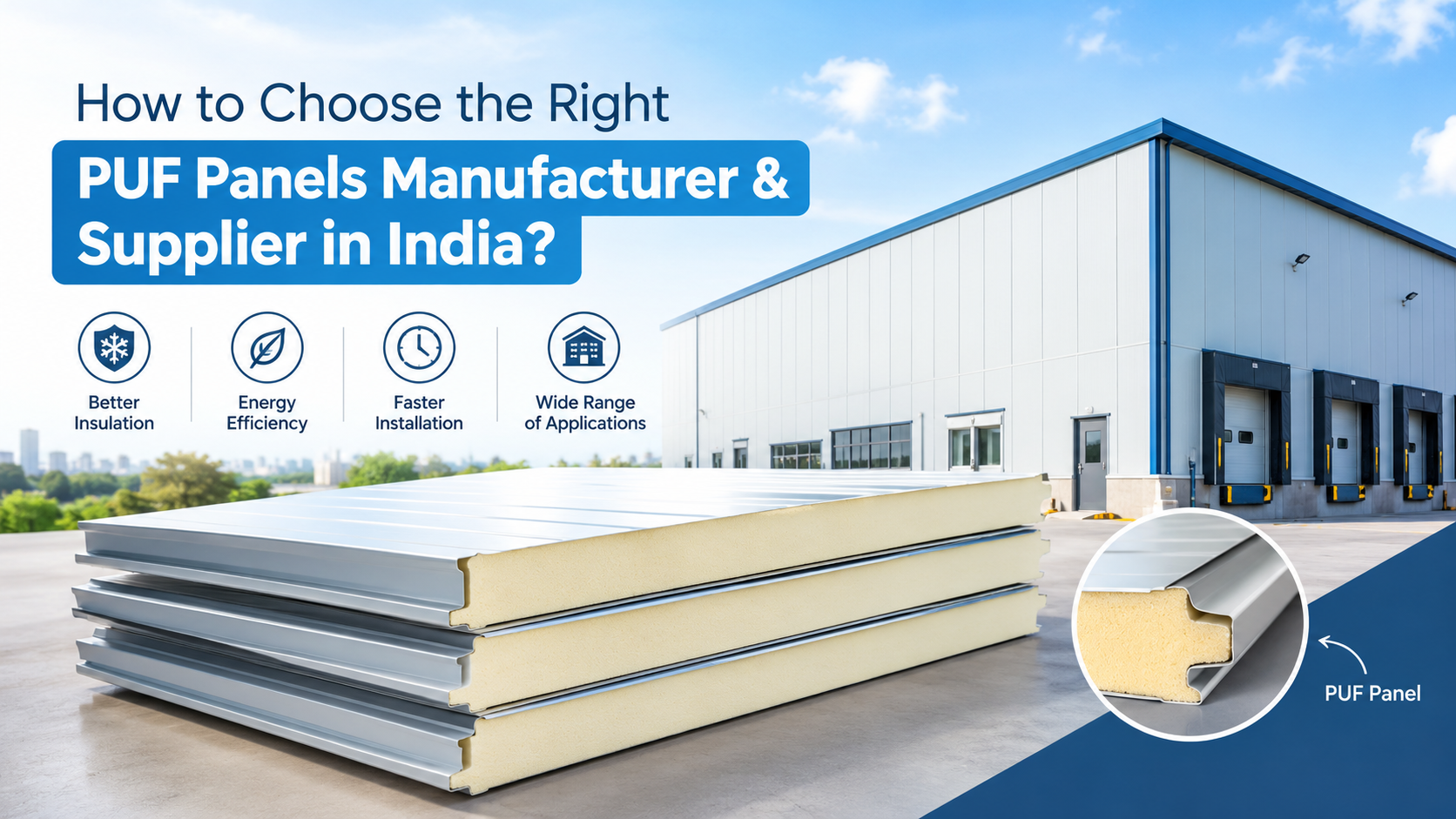
Choosing the right insulation material is an important step in modern construction. Whether you are planning an industrial facility, cold storage unit, warehouse, commercial building, or temperature-controlled space, proper insulation can help improve thermal performance and support energy efficiency. PUF panels are widely considered for such applications because of their insulating properties, lightweight structure, and versatile use.
However, the performance of an insulated building depends not only on the material but also on selecting suitable panel specifications and a reliable supplier. Finding the right PUF Panels Manufacturer & Supplier in India can help you choose products that match your project requirements, installation conditions, and long-term operational needs.
In this guide, we will explain what PUF panels are, where they are used, and which factors you should consider before selecting a supplier.
What Are PUF Panels?
PUF stands for polyurethane foam, a material known for its thermal insulation properties. PUF panels generally consist of an insulating polyurethane foam core placed between two facing sheets. Depending on the product design, these facings may be made from pre-coated metal sheets or other suitable materials.
The foam core helps reduce heat transfer between the inside and outside of a building. This makes PUF panels useful for applications where maintaining indoor temperatures is important.
PUF panels are available in different thicknesses, dimensions, profiles, and facing options. The appropriate selection depends on factors such as the intended application, temperature requirements, environmental conditions, and building design.
Where Are PUF Panels Used?
PUF panels are suitable for a variety of industrial and commercial applications. Their use depends on the required insulation performance, structural design, and installation conditions.
1. Cold Storage Facilities
Cold storage facilities require effective insulation to help maintain controlled temperatures. PUF panels are commonly considered for cold rooms, refrigerated storage areas, and temperature-controlled warehouses.
The correct panel thickness, joint design, and installation quality are important for limiting unwanted heat transfer and supporting refrigeration efficiency.
2. Industrial Buildings and Factories
Factories and industrial facilities may experience significant temperature variations throughout the day. Insulated panels can help create more controlled indoor environments when selected according to the building’s needs.
PUF panels can be used for walls, roofs, partitions, and selected enclosed areas, depending on the panel system and project specifications.
3. Warehouses and Distribution Centres
Warehouses often require practical building materials that support efficient construction and suitable indoor conditions. Insulated panels can be considered for storage spaces where temperature control or reduced heat gain is important.
For facilities storing temperature-sensitive products, insulation requirements should be assessed according to the products being handled.
4. Food Processing Units
Food processing facilities may require separate production areas, insulated enclosures, and temperature-controlled rooms. PUF panels can be used in suitable applications where thermal insulation is required.
The panel surface, joint details, cleaning requirements, and applicable hygiene standards should be reviewed before selecting a system for food-related environments.
5. Commercial and Prefabricated Buildings
PUF panels are also considered for certain commercial buildings, prefabricated structures, and modular spaces. Their relatively lightweight construction can support efficient installation when the building system is properly designed.
The suitability of a panel system depends on the intended use, local building requirements, and the project’s structural and fire-safety specifications.
Key Benefits of PUF Panels
Understanding the benefits of PUF panels can help buyers determine whether they are appropriate for a particular project.
Effective Thermal Insulation
Polyurethane foam is known for its low thermal conductivity compared with many conventional building materials. This property helps reduce heat transfer through insulated walls and roofs.
The actual thermal performance depends on foam quality, panel thickness, joints, and installation conditions.
Potential Energy Savings
In buildings that require cooling or controlled temperatures, effective insulation can reduce unwanted heat gain. This may help lower the cooling load and contribute to more efficient energy use.
Actual savings vary according to the building design, climate, equipment efficiency, operating hours, and other factors.
Lightweight Construction
PUF panels generally combine an insulating core with thin facing materials, making them relatively lightweight compared with some conventional wall and roof construction systems.
This can simplify handling and installation, subject to panel dimensions, lifting requirements, and site conditions.
Faster Installation
Many PUF panel systems are designed for assembly using compatible joints and fixing arrangements. When panels are properly specified and installed by trained personnel, they can help streamline construction compared with some traditional building methods.
Installation time depends on project size, site preparation, structural readiness, and detailing requirements.
Versatile Applications
PUF panels are available in different configurations for walls, roofs, partitions, and temperature-controlled enclosures. This flexibility makes them suitable for a range of industrial and commercial projects.
The selected panel must match the intended application rather than relying on a single specification for every building.
How to Choose the Right PUF Panels Manufacturer & Supplier in India
Selecting a supplier requires more than comparing product prices. Buyers should review technical specifications, product suitability, quality documentation, and the supplier’s ability to meet project requirements.
1. Check Product Specifications
Start by reviewing the technical details of the panels being offered. Important specifications may include:
- Panel thickness and dimensions
- Foam core type and density
- Thermal conductivity or declared thermal performance
- Facing material and coating
- Joint and connection design
- Applicable quality and safety documentation
These details help you compare products based on performance rather than price alone.
2. Select the Appropriate Panel Thickness
Panel thickness is an important factor in insulation performance. Thicker panels generally provide greater resistance to heat transfer when other relevant properties remain comparable.
However, the right thickness depends on the intended indoor temperature, outdoor climate, building use, refrigeration requirements, and applicable technical standards.
For example, a conventional warehouse and a low-temperature cold storage facility may require different insulation specifications. Consult a qualified technical professional or supplier to determine the suitable option for your application.
3. Evaluate Material Quality
The quality of the foam core and facing sheets affects the panel’s durability and performance. Ask the supplier for relevant technical data sheets, product specifications, and quality documentation.
Where required, review information about dimensional tolerances, facing thickness, coating specifications, and applicable test results.
Avoid making a selection based only on a general product description. Compare documented specifications to confirm that the panel meets your project’s requirements.
4. Understand Thermal Performance
Thermal performance should be evaluated using technical information rather than marketing claims alone. Ask for the declared thermal conductivity or other relevant performance data for the proposed panel.
You should also consider thermal bridges, panel joints, doors, windows, and other parts of the building envelope. Even an effective insulation material may deliver limited benefits if the complete system is poorly designed or installed.
5. Consider Fire Safety Requirements
Fire performance is an important consideration when selecting insulated panels for industrial and commercial buildings.
PUF panels contain a polymer foam core, and their fire behaviour depends on the product composition, facings, assembly, and tested system. Do not assume that every PUF panel offers the same fire performance.
Check the relevant fire-test documentation, building regulations, occupancy requirements, and project specifications before making a purchase. Where required, consult a qualified fire-safety professional.
6. Review Supplier Experience and Technical Support
A suitable supplier should be able to explain product specifications and help you identify options for your intended application.
Before placing an order, discuss the project dimensions, installation requirements, delivery schedule, accessories, and any technical documentation needed for approval.
Clear communication can help reduce misunderstandings during procurement and installation.
7. Compare Prices and Overall Value
Price is an important purchasing consideration, but the lowest quotation may not represent the best overall value.
When comparing quotations, check whether the products have equivalent specifications. Review panel thickness, facing materials, foam properties, accessories, transportation, installation scope, and applicable taxes.
A like-for-like comparison makes it easier to understand the differences between suppliers and identify an option that fits your project budget.
8. Confirm Availability and Delivery Requirements
Project schedules can depend on the availability of the required panel sizes, finishes, and accessories. Confirm the expected lead time and delivery arrangements before finalising your purchase.
For projects outside the supplier’s immediate location, discuss transportation, unloading, storage, and handling requirements in advance.
If you are sourcing from a PUF panels manufacturer and supplier in India, make sure the proposed delivery arrangements align with your construction schedule.
PUF Panels vs Conventional Insulation Materials
Different insulation materials serve different purposes. The best choice depends on the building design, temperature requirements, budget, environmental conditions, and applicable safety standards.
PUF panels are often considered where an integrated panel system and effective thermal insulation are required. Other options, such as mineral wool, glass wool, and extruded polystyrene, may be more appropriate for specific applications depending on their technical properties and the required assembly.
| Comparison factor | PUF panels | Other insulation systems |
| Thermal performance | Generally offers effective thermal insulation | Varies by material and thickness |
| Construction format | Often supplied as prefabricated panels | May be supplied as boards, batts, rolls, or other formats |
| Installation | Can support relatively quick assembly when properly designed | Depends on the insulation and construction system |
| Fire performance | Must be verified for the specific product and assembly | Varies by material and complete system |
| Suitable applications | Industrial buildings, cold rooms, roofs, walls, and partitions | Depends on material properties and project requirements |
The comparison should be based on documented product performance, total installed cost, and suitability for the intended building rather than on general assumptions about one material being best for every situation.
Common Mistakes to Avoid When Buying PUF Panels
A careful procurement process can help prevent avoidable issues during construction and operation.
Choosing panels based only on price: Lower-cost products may have different specifications. Compare equivalent technical details before making a decision.
Ignoring panel thickness: An unsuitable thickness may not provide the required insulation performance for a temperature-controlled space.
Overlooking fire requirements: Always review the relevant fire-safety documentation and building regulations for the proposed application.
Neglecting joint design: Poorly sealed joints can allow unwanted air leakage and reduce the effectiveness of an insulated enclosure.
Ignoring installation quality: Incorrect fixing, damaged facings, and inadequate sealing can affect long-term performance.
Not checking documentation: Request technical data sheets and relevant test reports where applicable so that the selected product can be evaluated properly.
Why Choose Pararth Products Pvt. Ltd. for Insulation Requirements?
Pararth Products Pvt. Ltd., based in Ahmedabad, Gujarat, operates in the insulation products sector. When evaluating insulation options for your project, you can contact the company to discuss your requirements and confirm the availability and specifications of suitable products.
Whether you are planning an industrial building, warehouse, cold storage facility, or another insulated space, begin by identifying your project’s temperature requirements, panel dimensions, facing preferences, and applicable safety standards.
Visit the Pararth Products website to explore the company’s insulation product offerings and enquire about relevant solutions.
Before purchasing, confirm the specific product range, technical specifications, delivery arrangements, and any project support available directly with the company.
Frequently Asked Questions About PUF Panels
1. What are PUF panels used for?
PUF panels are used in applications requiring thermal insulation, including cold storage facilities, industrial buildings, warehouses, insulated partitions, and certain prefabricated structures.
2. How do I choose the right PUF panel thickness?
The appropriate thickness depends on the required indoor temperature, outdoor conditions, thermal performance targets, building design, and applicable standards. A technical assessment can help determine the correct specification.
3. Are PUF panels suitable for cold storage?
Yes, PUF panels are commonly considered for cold storage applications because of their thermal insulation properties. The correct panel specification, joint sealing, and installation quality are important for maintaining the required temperature.
4. What should I check before buying PUF panels in India?
Review the foam core specifications, panel thickness, facing materials, thermal performance, fire-safety documentation, supplier support, pricing, and delivery schedule. Ensure the product meets the requirements of your intended application.
5. How can I compare PUF panel suppliers?
Compare suppliers using equivalent technical specifications, product documentation, quotation details, delivery commitments, and available technical assistance. This approach provides a clearer basis for evaluating product suitability and overall value.
6. Are PUF panels suitable for every building?
No. Their suitability depends on the building’s intended use, fire-safety requirements, environmental conditions, structural design, and insulation targets. Alternative materials may be preferable for some projects.
Conclusion
Selecting the right insulation material is an important part of planning an efficient and functional building. PUF panels offer useful thermal insulation properties and can be considered for industrial facilities, cold storage units, warehouses, and selected commercial applications.
When choosing a PUF Panels Manufacturer & Supplier in India, evaluate product specifications, insulation requirements, fire-safety documentation, installation considerations, pricing, and delivery arrangements. A well-informed selection can help you choose a panel system that aligns with your project’s technical needs and budget.
Pararth Products Pvt. Ltd. in Ahmedabad is a point of contact for businesses exploring insulation products. Visit pararthproducts.com to review its offerings and enquire about products suitable for your project.