
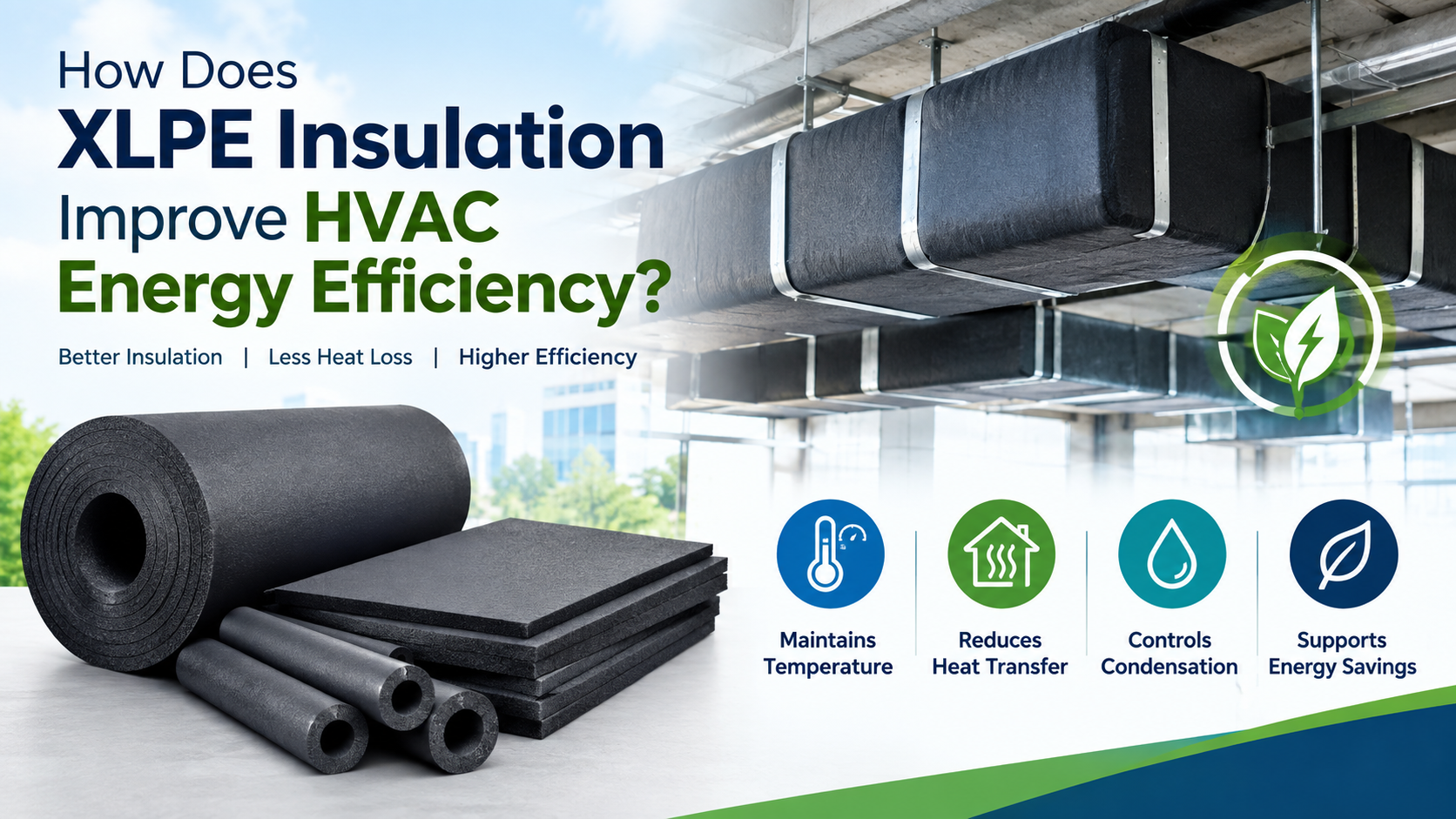
Heating, ventilation, and air conditioning (HVAC) systems play an important role in maintaining comfortable indoor temperatures in homes, offices, commercial buildings, hospitals, factories, and other facilities. However, an HVAC system can lose a significant amount of energy when ducts and pipes are not properly insulated.
This is where XLPE insulation can be useful.
XLPE, or cross-linked polyethylene, is a closed-cell insulation material commonly used for applications where thermal insulation and moisture resistance are important. When appropriately selected and installed around HVAC ducts and pipes, XLPE insulation can help reduce unwanted heat transfer, support temperature control, and improve the overall efficiency of an HVAC system.
But how exactly does XLPE insulation contribute to HVAC energy efficiency? Let’s understand the key factors.
What Is XLPE Insulation?
XLPE insulation is made from cross-linked polyethylene foam. Its closed-cell structure provides thermal insulation while also helping limit moisture penetration.
It is available in different forms and thicknesses for applications such as:
- HVAC duct insulation
- Pipe insulation
- Air-conditioning systems
- Refrigeration applications
- Under-deck insulation
- Thermal insulation applications
- Commercial and industrial projects
The appropriate insulation type and thickness depend on the application, operating conditions, installation environment, and required thermal performance.
For HVAC systems, the basic purpose of insulation is simple: to reduce unwanted heat transfer between the conditioned air or fluid and the surrounding environment.
Why Is Energy Efficiency Important in HVAC Systems?
HVAC systems consume energy to heat, cool, and circulate air or fluids. If conditioned air gains or loses heat while travelling through ducts, the system may need to work harder to maintain the desired temperature.
For example, consider a duct carrying cooled air through a hot area. Without adequate insulation, heat from the surrounding environment can transfer through the duct surface into the cooler air inside.
As a result, the air may reach its destination at a higher temperature than intended.
Proper insulation creates a thermal barrier around the duct and helps reduce this unwanted heat transfer.
This can contribute to better temperature control and help the HVAC system operate more efficiently.
How Does XLPE Insulation Improve HVAC Energy Efficiency?
1. Helps Reduce Unwanted Heat Transfer
One of the primary functions of insulation is to slow down heat transfer.
In an HVAC system, ducts may carry heated or cooled air through areas with different temperatures. Similarly, insulated pipes may transport chilled water, refrigerant-related fluids, or other temperature-controlled fluids depending on the system design.
XLPE insulation acts as a thermal barrier around the duct or pipe.
By reducing the rate at which heat moves between the system and its surroundings, insulation can help maintain the intended temperature for longer.
This is particularly useful when ducts or pipes pass through:
- False ceilings
- Service areas
- Plant rooms
- Utility spaces
- Exterior-facing areas
- Unconditioned spaces
2. Helps Maintain Conditioned Air Temperature
Maintaining the desired air temperature throughout the HVAC distribution system is important for efficient operation.
When air travels through an uninsulated or inadequately insulated duct, its temperature can change because of the surrounding conditions.
For a cooling system, unwanted heat gain can reduce the effectiveness of cooled air.
For a heating system, unwanted heat loss can have the opposite effect.
XLPE insulation helps create a barrier between the duct and surrounding environment, helping the air retain its intended temperature as it moves through the system.
3. Can Help Reduce HVAC System Load
When an HVAC system loses less heating or cooling energy during distribution, the system may not need to compensate as frequently or intensely for those losses.
This can help reduce unnecessary thermal load under suitable operating conditions.
However, insulation is only one part of overall HVAC efficiency. Equipment efficiency, system design, duct leakage, controls, maintenance, airflow, and operating conditions also influence energy consumption.
Therefore, XLPE insulation should be viewed as part of a broader HVAC energy-efficiency strategy.
4. Supports Temperature Stability
Energy efficiency is not simply about reducing energy consumption. Maintaining consistent temperatures is also important.
If conditioned air experiences significant temperature changes while travelling through ducts, the HVAC system may have to compensate to maintain indoor comfort.
Properly selected XLPE insulation can help minimize temperature variation caused by heat transfer through the duct or pipe surface.
This can be particularly valuable in large commercial or industrial buildings where HVAC distribution distances may be considerable.
How Does XLPE Insulation Help With Condensation?
Condensation can become a problem when the surface temperature of a duct or pipe falls below the surrounding air’s dew point.
For example, chilled-air ducts or cold pipes may have significantly lower surface temperatures than the surrounding environment. If the external surface is not adequately protected, moisture from the surrounding air can condense on it.
This can lead to:
- Wet insulation
- Moisture-related deterioration
- Ceiling or surface damage
- Unwanted dripping
- Reduced insulation performance
XLPE’s closed-cell structure can provide resistance to moisture penetration when the insulation system is properly selected, installed, and sealed.
This makes moisture control another important consideration when choosing insulation for certain HVAC applications.
Why Is Closed-Cell Structure Important?
The structure of an insulation material can influence how it performs in practical applications.
XLPE insulation has a closed-cell foam structure. The cells are largely enclosed rather than forming an open network.
This structure can provide useful characteristics for HVAC applications, including:
- Thermal insulation
- Resistance to moisture penetration
- Lightweight construction
- Flexibility
- Ease of handling
- Suitability for various duct and pipe applications
The actual performance of any insulation system depends on the material specifications, thickness, installation quality, joints, environmental conditions, and application requirements.
Does XLPE Insulation Help Reduce Energy Loss in HVAC Ducts?
Yes, appropriately selected and installed XLPE insulation can help reduce thermal energy loss from HVAC ducts.
Imagine a cooling duct passing through a warm service area.
The surrounding temperature is higher than the temperature of the air inside the duct. Without sufficient insulation, heat can move from the warmer surroundings toward the cooler air.
Insulation increases the thermal resistance around the duct and slows this heat transfer.
The same principle applies in reverse to heating systems, where insulation can help reduce heat loss from warmer air to the cooler surroundings.
The result is better thermal protection of the conditioned air during distribution.
XLPE Insulation for HVAC Pipes
HVAC efficiency is not limited to air ducts.
Many HVAC systems also use pipes for transporting temperature-controlled fluids. Depending on the system, these can include chilled-water or other service lines.
Insulating these pipes can help reduce heat transfer between the pipe contents and the surrounding environment.
XLPE pipe insulation can therefore be considered for suitable HVAC piping applications where thermal protection and moisture resistance are required.
The correct thickness should be selected according to the pipe size, operating temperature, ambient conditions, and project requirements.
What Factors Affect XLPE Insulation Performance?
Choosing insulation based only on the material name is not enough. Several factors influence how effectively an insulation system performs.
Insulation Thickness
Thickness is an important consideration because different applications have different thermal requirements.
A thicker insulation layer generally provides greater thermal resistance, but the appropriate thickness should be determined according to the application’s technical requirements rather than simply selecting the thickest available option.
Installation Quality
Even good-quality insulation can perform poorly if it is installed incorrectly.
Gaps, damaged sections, poorly joined pieces, or insufficient sealing can create pathways for heat transfer and moisture.
Proper installation is therefore essential.
Joint Sealing
Particular attention should be given to joints and connections.
If joints are not properly sealed, moisture and air can potentially enter areas where they should not.
The installation method and sealing materials should be appropriate for the insulation system and application.
Operating Temperature
HVAC systems operate under different temperature conditions.
The insulation selected should be suitable for the expected operating temperature range of the application.
Environmental Conditions
The location of the duct or pipe also matters.
An insulation system installed in a conditioned indoor space may face different conditions from one installed in a humid service area or other unconditioned location.
Duct and Pipe Design
Duct dimensions, pipe diameter, system layout, bends, connections, and available installation space can all influence insulation requirements.
What Are the Benefits of XLPE Insulation for HVAC Applications?
When correctly selected and installed, XLPE insulation can offer several practical benefits.
Thermal Insulation
It helps reduce unwanted heat transfer between HVAC components and the surrounding environment.
Moisture Resistance
Its closed-cell structure can provide resistance to moisture penetration, which is useful for applications where condensation control is important.
Lightweight Material
XLPE insulation is relatively lightweight, which can make handling and installation more convenient.
Flexible Construction
Its flexibility can help when insulating ducts, pipes, bends, and other HVAC components with suitable products.
Easy Handling
XLPE products can be easier to cut and handle during installation compared with some heavier insulation materials.
Support for Energy-Efficient HVAC Systems
By reducing thermal losses from ducts and pipes, insulation can contribute to the overall energy-efficiency strategy of an HVAC installation.
XLPE Insulation vs Leaving HVAC Ducts Uninsulated
The difference between insulated and uninsulated HVAC distribution components can be significant in environments where temperature differences exist.
| Factor | With Suitable XLPE Insulation | Without Adequate Insulation |
| Heat transfer | Reduced | Higher potential for heat transfer |
| Temperature maintenance | Better supported | Greater temperature variation possible |
| Condensation control | Can help when properly designed and sealed | Greater risk on cold surfaces |
| Thermal protection | Improved | Limited |
| HVAC efficiency | Can support efficient operation | Thermal losses may increase |
| Surface protection | Provides an insulation layer | Duct/pipe remains exposed |
Actual performance depends on the complete HVAC system, material specifications, installation, and operating conditions.
Where Is XLPE Insulation Commonly Used?
XLPE insulation can be used in various thermal insulation applications.
In HVAC projects, applications may include:
- Air-conditioning ducts
- HVAC pipes
- Chilled-water lines
- Air distribution systems
- Under-deck applications
- Commercial buildings
- Industrial facilities
- Residential projects
- Service areas and utility spaces
The suitability of XLPE should always be evaluated according to the project’s technical requirements.
How to Choose the Right XLPE Insulation?
Before purchasing XLPE insulation, consider the following factors:
1. Application
First, determine whether the insulation is required for a duct, pipe, equipment, under-deck application, or another purpose.
2. Required Thickness
Choose the appropriate thickness based on the thermal requirements and operating conditions of the system.
3. Operating Temperature
Check that the selected insulation is appropriate for the expected temperature range.
4. Moisture Conditions
For chilled-air ducts and cold pipes, condensation and moisture control should be considered during material selection and installation planning.
5. Product Dimensions
The insulation should be compatible with the dimensions of the duct or pipe.
6. Installation Requirements
Consider how the material will be cut, fitted, joined, sealed, and maintained once installed.
7. Supplier Capability
For larger HVAC projects, buyers should also consider the supplier’s product range, technical information, consistency, and ability to meet project requirements.
Why Choose the Right XLPE Insulation Supplier?
The quality of an insulation installation depends on more than simply selecting XLPE as a material.
A suitable supplier can help you identify products based on:
- Application
- Required dimensions
- Thickness
- HVAC system requirements
- Project quantity
- Installation conditions
For contractors, HVAC professionals, builders, and project procurement teams, having access to the appropriate XLPE insulation products can make project planning and installation easier.
Pararth Products offers insulation products for different applications, including XLPE insulation for duct and pipe insulation requirements. Buyers can review the available product specifications and select the option that matches their project needs.
Frequently Asked Questions
What is XLPE insulation used for?
XLPE insulation is used for thermal insulation applications such as HVAC ducts, pipes, air-conditioning systems, and other applications where reducing heat transfer and controlling moisture are important.
Does XLPE insulation improve HVAC efficiency?
Appropriately selected and installed XLPE insulation can help reduce unwanted heat transfer through HVAC ducts and pipes. This can support temperature maintenance and the overall energy efficiency of the HVAC system.
Is XLPE suitable for duct insulation?
XLPE can be used for suitable HVAC duct insulation applications. The appropriate product thickness and installation method should be selected based on the duct design and operating conditions.
Can XLPE insulation be used for pipes?
Yes. XLPE insulation is available for suitable pipe insulation applications, including HVAC-related piping. The correct product should be selected according to pipe dimensions, operating temperature, and project requirements.
Does XLPE insulation help prevent condensation?
XLPE’s closed-cell structure can help resist moisture penetration and support condensation control when the insulation is correctly selected, fitted, and sealed. Proper installation is particularly important for cold HVAC surfaces.
How do I choose XLPE insulation thickness?
The required thickness depends on factors such as operating temperature, ambient conditions, application, pipe or duct size, and project requirements. It is better to select thickness based on the technical requirements of the application rather than using a single thickness for every project.
Final Thoughts
XLPE insulation can play an important role in improving the thermal performance of HVAC ducts and pipes. By reducing unwanted heat transfer, helping maintain conditioned air temperature, and supporting condensation control, properly selected insulation can contribute to a more efficient HVAC system.
However, insulation works best as part of a complete HVAC strategy. Proper duct design, sealing, equipment selection, airflow management, maintenance, and installation quality also influence overall energy performance.
For projects requiring XLPE insulation for HVAC ducts, pipes, and related applications, selecting the right product specifications and working with an experienced insulation supplier can help ensure that the insulation system is appropriate for the intended application.
Pararth Products provides XLPE insulation solutions for suitable HVAC and thermal insulation applications. Before selecting a product, review the required thickness, dimensions, operating conditions, and installation requirements for your specific project.