
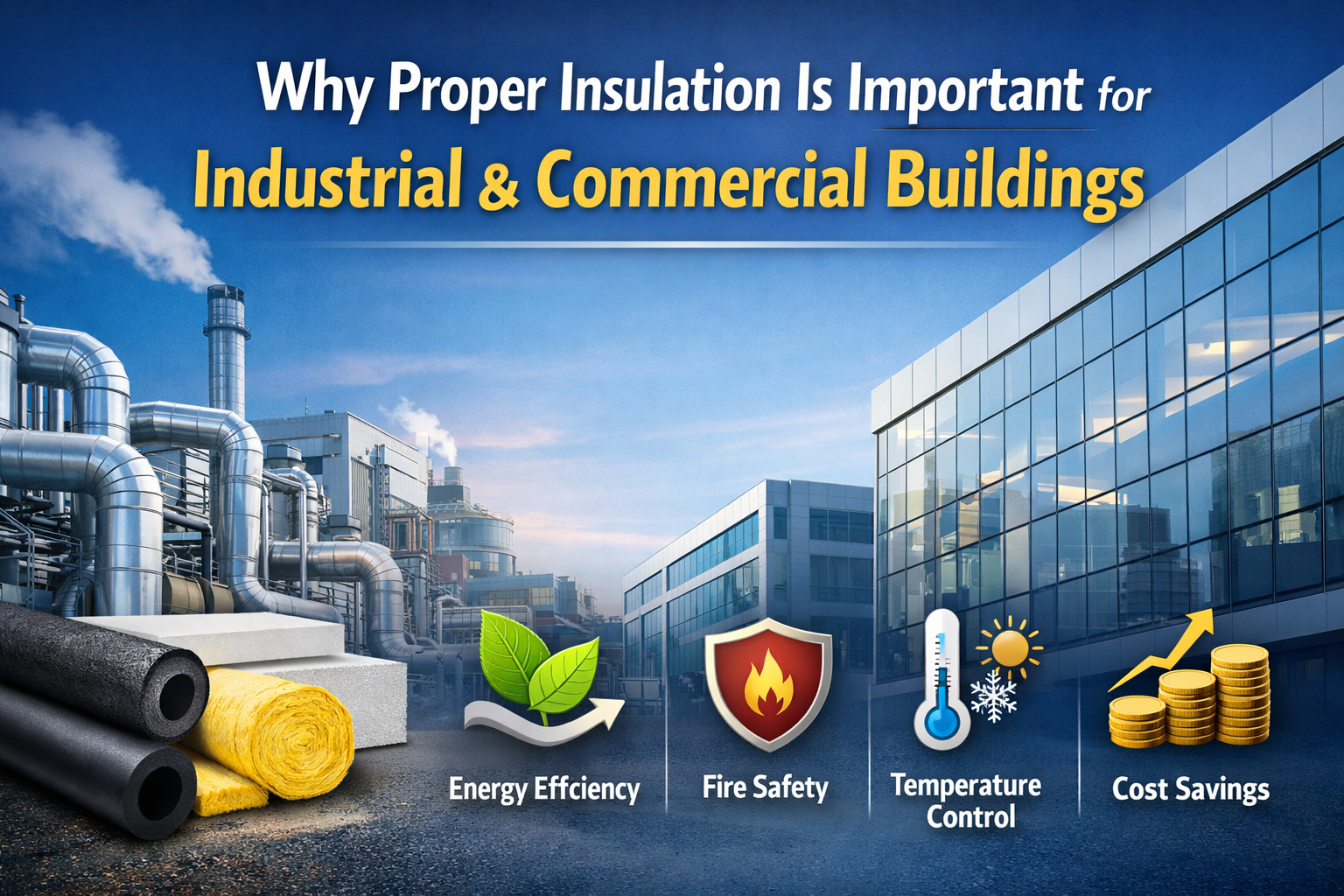
Insulation plays a critical role in maintaining energy efficiency, safety, and comfort in industrial and commercial buildings. Without proper insulation, buildings experience excessive energy loss, higher operating costs, and reduced system performance.
This article explains why insulation is important, how it impacts building performance, and why it is a long-term investment rather than an expense.
What Is Insulation and How Does It Work?
Insulation is a material that slows down heat transfer between surfaces.
It helps keep heat inside during cold conditions and blocks excess heat during warm conditions.
In industrial and commercial buildings, insulation is used in:
- Walls and roofs
- HVAC ducts and piping
- Machinery and equipment
- Cold storage areas
Key Benefits of Proper Insulation
Improved Energy Efficiency
Proper insulation reduces heat loss and heat gain, allowing HVAC and mechanical systems to operate more efficiently.
Lower Energy Costs
With reduced energy demand, electricity and fuel consumption decrease, resulting in significant cost savings.
Enhanced Indoor Comfort
Insulated buildings maintain stable indoor temperatures, improving comfort for workers and occupants.
Importance of Insulation in Industrial Buildings
Industrial environments involve high temperatures, heavy machinery, and continuous operations.
Proper insulation helps:
- Reduce heat loss from pipelines and equipment
- Maintain process temperatures
- Improve worker safety
- Reduce equipment wear and tear
Importance of Insulation in Commercial Buildings
In commercial buildings, insulation improves:
- Thermal comfort
- Acoustic performance
- HVAC efficiency
- Overall building lifespan
This makes insulation essential for offices, malls, hospitals, and warehouses.
Role of Insulation in Fire Safety
Certain insulation materials provide fire-resistant properties, helping slow the spread of fire and improve safety standards in industrial and commercial spaces.
Fire-safe insulation is particularly important in:
- Factories
- Power plants
- Chemical units
- Warehouses
Environmental Benefits of Insulation
Proper insulation reduces energy consumption, which leads to:
- Lower carbon emissions
- Reduced environmental impact
- Support for sustainable building practices
Common Areas That Require Insulation
- HVAC ducts and piping
- Industrial machinery
- Building roofs and walls
- Cold storage facilities
Identifying these areas helps maximize insulation effectiveness.
Insulation as a Long-Term Investment
Although insulation requires an initial investment, it provides:
- Long-term energy savings
- Reduced maintenance costs
- Extended equipment lifespan
- Improved building performance
When Should Insulation Be Installed or Upgraded?
Insulation should be considered:
- During new construction
- While upgrading HVAC systems
- When energy costs are high
- If temperature control is inconsistent
Conclusion
Proper insulation is essential for energy efficiency, safety, comfort, and cost control in industrial and commercial buildings.
Investing in the right insulation solution ensures long-term performance and operational savings.
Need Expert Insulation Guidance?
Choosing the right insulation depends on building type, operating conditions, and safety requirements.
Professional consultation helps ensure the best results.